The question usually arrives at a specific moment. Something is going on with your skin, you have looked at what a visit costs either way, and you cannot tell whether you need a doctor or a facial. It feels like a judgment call you are not qualified to make.
It is more knowable than that. The line between an esthetician and a dermatologist is not a matter of skill or seniority - it is a licensing boundary, it is written down, and once you know where it sits you can usually place your own concern on the right side of it in about thirty seconds. Here is the honest version from a licensed esthetician at a Plano med spa, with the sources so you can check the claims rather than take our word for them.
The one-line version
If something on your skin is changing, spreading, painful, bleeding, or has not responded to treatment, book a board-certified dermatologist first. If your skin is healthy and you want it to look and feel better - texture, congestion, dullness, dehydration, early lines, leftover marks - an esthetician is the right place to start.
The Short Answer
A dermatologist is a medical doctor. An esthetician is a licensed skin care professional. One diagnoses and treats disease and can write prescriptions; the other maintains and improves the appearance and condition of healthy skin. They are not competitors and they are not interchangeable.
The most common mistake we see is not people picking the wrong professional. It is people waiting too long to see the doctor because they were hoping a facial would take care of it. A treatment that soothes and resurfaces cannot fix something that needs a diagnosis, and no amount of money spent on facials will change that.
Training: What Sits Behind Each Title
The American Academy of Dermatology defines the role plainly: "A dermatologist is a medical doctor who specializes in conditions that affect the skin, hair, and nails." Getting there takes what the AAD calls "more than a decade of training" - four years of college, four years of medical school, a year-long internship in medicine, and three years of dermatology residency "working alongside experienced doctors and completing 12,000 to 16,000 hours of treating patients."
Board certification adds a final exam on top of that. The payoff, per the AAD, is a physician who can "accurately diagnose and properly treat more than 3,000 diseases of the skin, hair, and nails as well as cosmetic concerns." That number is the real point of the comparison. Dermatology is a diagnostic specialty first.
An esthetician in Texas is licensed by the Texas Department of Licensing and Regulation (TDLR) rather than by a medical board. The training is skin-specific coursework and a state licensing exam, measured in hours rather than years. It is a narrower education attached to a narrower license, and that is by design - the license covers the surface of healthy skin and stops there.
What a Texas Esthetician License Covers
This part is public and specific, and it is worth reading once. TDLR publishes a scope of practice guide for estheticians listing exactly what the license authorizes:
- "Cleansing treatments of face, neck, scalp, shoulders or arms"
- "Beautifying treatments of face, neck, shoulders, or arms"
- "Facial treatments"
- "Massaging scalp, neck, shoulders, arms, or face by hand or by using a device, apparatus or appliance"
- "Body hair removal" using "depilatories, preparations or chemicals, tweezers, or other devices"
- "Eyelash extensions" using "semipermanent, threadlike extensions composed of applying single fibers"
Now notice what is absent. There is no diagnosis on that list, no prescribing, no biopsy, no excision, and nothing about treating a disease. That is not an oversight in the rules - it is the edge of the profession. An esthetician who glances at a mole and tells you it is "probably nothing" is speaking outside their license, and you should weigh the reassurance accordingly.
When You Should See a Dermatologist
Some things are a physician's job, and delaying them to try a treatment first is the wrong trade. Book the dermatologist when any of the following is true.
A spot or mole is changing
This one is not negotiable. The AAD's ABCDEs of melanoma are the standard self-check:
- A is for Asymmetry - "One half of the spot is unlike the other half."
- B is for Border - "The spot has an irregular, scalloped, or poorly defined border."
- C is for Color - "The spot has varying colors from one area to the next, such as shades of tan, brown or black, or areas of white, red, or blue."
- D is for Diameter - "While melanomas are usually greater than 6 millimeters, or about the size of a pencil eraser, when diagnosed, they can be smaller."
- E is for Evolving - "The spot looks different from the rest or is changing in size, shape, or color."
The AAD's instruction is equally direct: "If you notice any new spots on your skin, spots that are different from others, or spots that are changing, itching or bleeding, make an appointment to see a board-certified dermatologist." We will not treat over a spot like that, and we will tell you why.
Acne that is not responding
The AAD sets a usable threshold here. You benefit from seeing a dermatologist when acne "causes acne cysts and nodules (deep blemishes that can leave scars when they clear)," when it "hasn't cleared with treatment you can buy without a prescription," or when it "makes you feel uncomfortable, and you want clearer skin."
How long is long enough to decide something is not working? The AAD's guidance is to "give an acne treatment at least 4 weeks to work," with some improvement visible in four to six weeks and full clearing taking two to three months or longer. If you have been consistent well past that window with no change, you have your answer - and prescription options are a dermatologist's to offer, not ours.
Anything that needs a name before it needs a treatment
Rashes, persistent itching, hair loss, nail changes, and redness that might be rosacea, eczema, psoriasis, or perioral dermatitis all fall here. An esthetician can see that skin is inflamed. Only a physician can tell you what the inflammation is, and the right treatment depends entirely on that answer.
When an Esthetician Is the Right Call
The other half of the line is just as clear. If your skin is healthy and your goal is how it looks, feels, and holds up over time, this is precisely what estheticians train for - and it is work a short medical appointment is not built to deliver.
- Congestion, blackheads, and extractions - hands-on clearing work that takes real chair time. Our HydraFacial menu starts at $190.
- Texture, early fine lines, and collagen support - microneedling and nanoneedling, $150 to $600 depending on the tier.
- Dullness, dehydration, and uneven tone - clinical and corrective facials from $160, each built around one defined concern.
- Surface pigment and clarity - chemical peels at $225, including our Mandeliclear peel for pigment and acne.
- Maintenance - the every-four-to-six-week rhythm that holds a result in place rather than chasing it once a year.
There is also a quiet benefit to the appointment itself, even though it is not a medical one. Every visit here starts with a professional skin analysis, which means someone is looking closely at your skin on a regular schedule. That is how a fair number of our clients ended up at a dermatologist in the first place.
Where a Med Spa Sits Between the Two
A medical spa is the middle category, and it is a real one rather than a marketing word - but only when the medical part is genuine. In Texas, certain procedures count as medical acts no matter where they are performed, and supervision requirements come with them.
Texas Medical Liability Trust's summary of medical spa regulation in Texas states the supervision standard as "a physician, physician assistant (PA) or advanced practice registered nurse (APRN) is on site, or a physician, PA, or APRN must be immediately available for an emergency consult," and is blunt about where responsibility lands: "Regardless of who performs the procedure, the supervising physician is responsible for the safety of the patient and for all aspects of the procedure."
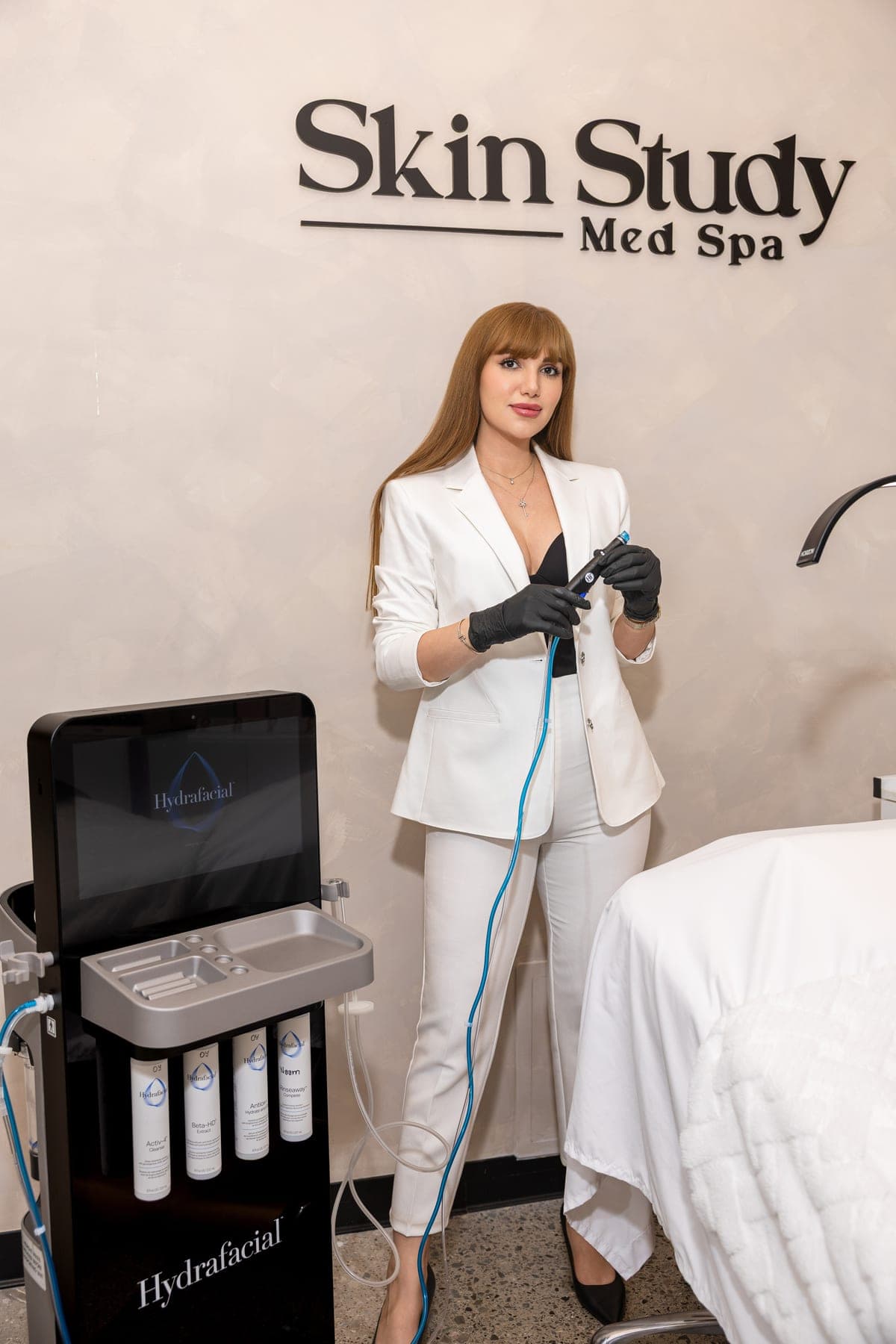
At Skin Study Med Spa, treatments are performed by founder and licensed esthetician Leila Razipoor, and our clinical protocols are overseen by our Medical Director, Dr. Brady Steineck, MD. You can read how that works in practice on our methodology page, and meet both of us on the team page.
It is a fair question to ask any med spa you are considering: who is the medical director, and what do they actually oversee? If the answer is vague, that tells you something useful.
Most People Need Both, in Sequence
Framing this as "esthetician vs dermatologist" implies you pick one and stay there. In practice the useful order is usually doctor first for the diagnosis, esthetician after for the maintenance.
The clearest example is acne. Someone with inflammatory, cystic acne gets a prescription plan from a dermatologist, because that is the only thing that will work. Once the active breakouts are under control, the leftover texture and discoloration are a different problem entirely - and that part is ours. Our guide to microneedling vs chemical peels for acne scars covers how we approach that second stage.
It runs the other direction too. If you book a facial and we see something that belongs with a physician, we will say so, and we will not sell you a treatment we do not think you should have. Medications matter here as well: isotretinoin and several other prescriptions change what we can safely perform, which is one of the reasons we ask. Our editorial policy holds our published content to the same standard.
Booking in Plano
If you have read this far and landed on the esthetician side of the line, that is what we do. Every appointment at our West Plano studio begins with a skin analysis, and the recommendation you get is the one your skin needs that day - including the recommendation to see a doctor first, when that is the honest answer.
Our clients have made us a 5.0-star studio across 62 Google reviews, and a fair share of that comes from telling people plainly what a treatment will and will not do. Browse the full treatment menu or get in touch and we will help you work out which appointment you actually need.