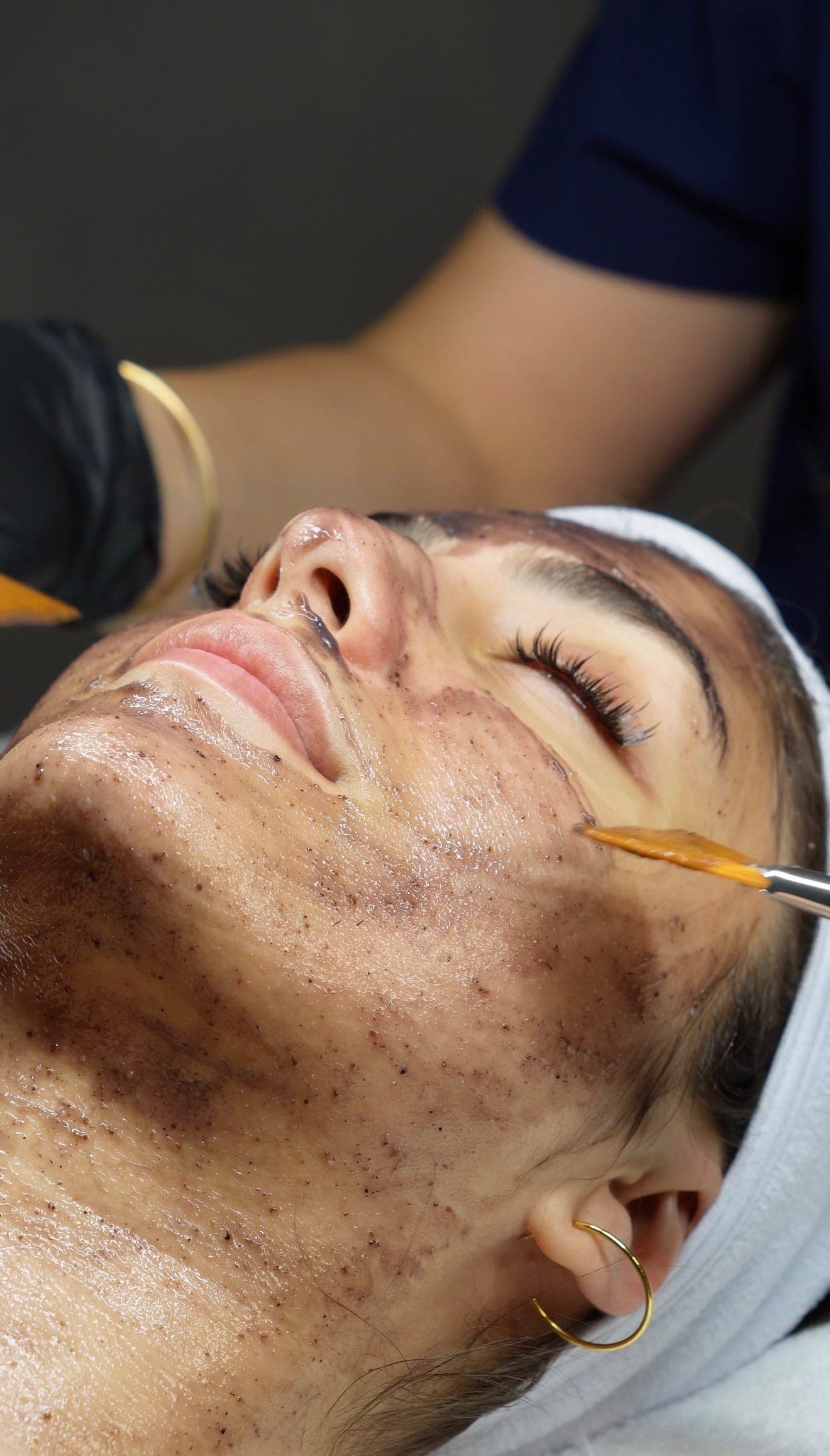
Search for the best chemical peel for hyperpigmentation and you get a ranked list of acids, as though pigment were one problem with one winner. It is not. Melasma, sun spots, and the flat brown marks left behind by a breakout are three different processes, they respond at three different rates, and one of the things people bring us under this heading is not pigment at all.
We run three Circadia peels at our studio in Plano, all $225. This page tells you which one we reach for when the concern is uneven tone, what the published evidence actually supports, and the situations where the right answer is not a peel and we will say so.
The one-line version
Of our three peels, the Mandeliclear is the pigment peel - a corrective mandelic acid peel with a Vitamin A accelerator, 30 minutes, $225. But the peel is the second decision. The first is what kind of pigment you are looking at, because that determines whether a peel is a good instrument, a supporting one, or the wrong one. And the thing that decides whether any of it holds is daily sunscreen, not the acid.
The Short Answer
If your concern is uneven tone, dark patches, or post-breakout marks, the Mandeliclear Chemical Peel ($225, 30 minutes) is the peel on our menu built for it. It is corrective rather than a full facial, and it is the one treatment here that may leave some dryness or light peeling for a few days.
If the pigment sits on skin that is also dry, dull, or mature, the Lactic Acid Peel Facial ($225, 60 minutes) is often the better opening move - gentler, no downtime, and lactic acid is not a weak choice for pigment. The first pilot study on it, summarized in a review of chemical peels for melasma in dark-skinned patients, applied 92% lactic acid for up to six sessions and found "a significant fall in MASI (56%)" across the patients who completed it.
And if the dark marks keep appearing because the breakouts keep appearing, the Alpha-Beta Peel Facial ($225, 60 minutes) is the one that addresses the cause. Clearing congestion stops you from producing new marks, which matters more over a year than fading the current ones faster.
One honest caveat up front: that same review concluded that for melasma in deeper skin tones, "the traditional glycolic peels prove to be the best both in terms of safety as well as efficacy." We do not carry a straight glycolic peel. If that is specifically what you want, a dermatologist's office is the place to get it, and that is a perfectly good outcome of a consultation here.
First, What Kind of Pigment Is It?
The American Academy of Dermatology's overview of chemical peels lists what dermatologists use them to treat, and the pigment entries are specific: "Age spots," "Discoloration (blotchy complexion, uneven skin tone)," "Dull complexion," "Freckles," "Melasma," and "Sun-damage skin." That is a real list. It is not a promise that all six respond equally.
Most people have a mixture, which is normal and is why a plan usually has more than one component. If the last three rows sound like you, our acne scars guide walks through the scar-versus-spot test in detail, including the trick of raking light across your cheek instead of looking at it straight on.
Depth matters too. The AAD notes that a melasma treatment plan takes into account "your skin tone, how deeply the melasma reaches into your skin, and any melasma triggers you may have." A superficial peel works on the epidermis. Pigment sitting deeper than that is not something a 30-minute peel reaches, no matter how many of them you buy.
Which of Our Three Peels, and Why
All three are Circadia professional peels and all three are $225. The difference is what they are built to do.
If peeling is a non-starter for you - a client-facing job, an event in ten days, skin that reacts to everything - say so at the consultation. The Brightening Vitamin C Facial at $160 is the no-downtime route to the same goal, and our guide to facials for acne, rosacea and hyperpigmentation covers that path properly.
Why Mandelic Acid for Pigment-Prone Skin
The reason mandelic acid turns up in pigment protocols is molecular size. In their review "Chemical Peels for Melasma in Dark-Skinned Patients" (Sarkar, Bansal and Garg, Journal of Cutaneous and Aesthetic Surgery, 2012), the authors put it plainly: "Mandelic acid is one of the largest alpha hydroxy acids which penetrates the epidermis slowly and uniformly, making it an ideal peeling agent for sensitive skins."
Slow and uniform is the whole point when you are treating pigment, because the thing that makes pigment worse is inflammation. An acid that goes deep and unevenly in a hurry is working against you even when it looks impressive on the day. A larger molecule buys you a more predictable pass.
The same review reports that salicylic-mandelic peels "proved to be more efficacious for both active acne as well as post-acne hyperpigmentation as compared to the traditional GA peels" and that "the side effects were also lesser." Read that carefully, because we are not going to overstate it: the comparison tested a salicylic-mandelic combination, not the formula we use, and the authors note there was no published melasma data for it at the time. What transfers is the behavior of the mandelic molecule. The study result does not transfer, and any page telling you otherwise is selling.
One Peel Will Not Do It
This is the expectation that causes the most disappointment, so here are the numbers from people with no stake in your booking. The AAD's chemical peel FAQs state that for a refreshing or lunchtime peel, "3 to 5 peels may be necessary to give you the desired results," and that "these peels may be repeated every 2 to 5 weeks."
For melasma the figure runs higher, and the review above explains why: peels "work by the temporary removal of cutaneous melanin without any action on the process of melanogenesis or melanocytes," so the recommended approach is "multiple sessions of chemical peels (usually about 5-6) at a two- to four-week interval along with additional maintenance therapy." The acid removes pigment that is already there. It does not tell your skin to stop making more.
And the clock is longer than the session count suggests. On melasma, the AAD says that "when you follow your treatment plan, it usually takes between 3 to 12 months to see results," and that it may take longer if you have had melasma for a long time.
What that means for your budget
At $225 a peel, a 3-to-5 session course is $675 to $1,125, and a 5-to-6 session melasma course is $1,125 to $1,350 before maintenance. We would rather you see that arithmetic now than after the second appointment. If it is not the right spend for you this year, the honest alternative is sunscreen plus one active ingredient at home, which costs a fraction and is the part doing the long-term work anyway. Our full price list is published for exactly this reason.
Also worth knowing before you start: the AAD notes that "most results are not permanent because our skin continues to age," and that if you have a lot of sun-damaged skin "you will likely continue to see new spots and growths on your skin." Maintenance is not an upsell invented by med spas. It is how this category works.
The Part Nobody Advertises: A Peel Can Make Pigment Worse
Among the possible side effects of a chemical peel, the AAD lists "temporary darkening of the skin." For pigment-prone skin that is not a footnote - it is the central design constraint of the treatment.
The Sarkar review opens on exactly this point: "Dark skin types (Fitzpatrick types IV to VI) are especially difficult to treat owing to the increased risk of post-inflammatory hyperpigmentation (PIH)." It goes on to note that "in darker races, the choice of the peeling agent becomes relatively limited; so, there is the need for priming agents and additional maintenance peels."
The AAD is blunt about where that leaves you: "Even people who have skin of color can safely have a chemical peel - but they should see a dermatologist who has expertise using chemical peels to treat darker skin tones. Without this knowledge, people who have skin of color (i.e., African American, Asian, Latino) can develop permanent pigment problems." We are an esthetician-led studio, not a dermatology practice, and you should weigh that sentence rather than hear it for the first time afterward. Where the line between the two sits in Texas is the subject of our esthetician vs dermatologist guide.
What we do about it on our side is unglamorous: start at the gentlest option that can work, space the sessions properly, and decline to go harder because someone asks us to. Every appointment opens with a skin analysis, and on pigment-prone skin that analysis is the treatment decision - our methodology page sets out how it works. The AAD's own framing is that "the results you see after getting a chemical peel depend largely on the skill of the person performing the peel."
Preparation earns its keep here too. The AAD notes that "before getting a chemical peel, some patients need to follow a pre-peel skin care plan for 2 to 4 weeks," which "can improve results and reduce potential side effects." In the melasma literature that step is called priming, and it "ensures uniform penetration of the peeling agent, enhances healing and maintains the effects achieved with the chemical peel." The classic priming agent is hydroquinone, which the AAD notes "is no longer available in products that you can buy without a prescription" - so prescription priming is your physician's call, not ours. What we can set up is a non-prescription prep routine in the weeks before a first peel.
Do not do this at home
The AAD carries an FDA warning on its chemical peel pages: "Some chemical peels sold for at-home use are causing serious injuries." The FDA "advises you to buy and use a chemical peel only under the supervision of a licensed, trained provider." A burn on pigment-prone skin does not resolve into even tone - it resolves into darker tone that takes months to settle. There is no version of this worth saving $225 on.
Sunscreen Is Not Aftercare. It Is the Treatment
If you take one thing from this page, take this one. The AAD's melasma treatment guidance is direct: "Sunlight causes the skin to make more pigment, which can darken existing melasma and cause new patches." Pigment treatment without sun discipline is a subscription rather than a plan - and a North Texas summer is not a forgiving place to run one.
The AAD's recommendation for people with melasma is a broad-spectrum sunscreen at "SPF 30 or higher" applied "throughout the day," and it is specific about the filters worth looking for: "Zinc oxide," "Titanium dioxide," and "Iron oxide." If the white cast is what makes you skip it, the Academy's own suggestion is to "consider using a tinted sunscreen" - and the iron oxide in most tinted formulas is doing real work, because visible light drives pigment too and a clear sunscreen does not filter it.
After a peel the stakes go up rather than down. The AAD states that your "risk for developing an infection or scarring increase dramatically" if you "fail to protect your skin from the sun," and says to skip indoor tanning entirely because "your skin will not heal properly." Then: "after your skin heals, apply sunscreen every day. This will help you maintain results."
The at-home actives that pair with a peel series are a short list - the AAD's version is azelaic acid, glycolic acid, kojic acid, a retinoid, or vitamin C, used one at a time rather than all at once - and we cover it in the dark spots section of our acne scars guide.
When a Peel Is the Wrong Tool
There are four situations where the honest recommendation is not a peel at all, and you should hear them from the studio rather than discover them after a series.
- Stubborn or deeper melasma. The AAD's medication list for melasma - hydroquinone, tretinoin with a mild corticosteroid, triple combination cream, and for difficult cases tranexamic acid, which "you may apply to your skin or take as a pill" - is prescription territory. The Academy also states that "only a board-certified dermatologist should perform" the procedures it recommends adding to a melasma plan. A peel series here is an adjunct to that care, which is precisely how the melasma literature describes it: "only a second-line agent or an adjunct to topical therapies."
- Depressed scarring mixed in with the pigment. Color work does not fill a dent. Microneedling is the collagen-building option on our menu, and the microneedling vs chemical peel comparison is the longer version of that decision.
- Active, inflamed acne. Treating the breakouts comes first, because every new lesion is a new mark in the making. That usually starts with the Acne Treatment Facial at $200 rather than a corrective peel.
- A spot that is new, changing, itching, or bleeding. That is a dermatologist appointment, not a cosmetic one, and nothing on our menu should come before it.
One more thing worth saying about melasma, because it reframes the whole plan: the AAD notes that it "may go away on its own," usually "when a trigger, such as pregnancy or a medication, causes melasma," but that it "can also last for years, or even a lifetime." Triggers include "sunlight, taking birth control pills, and even stress." Chasing a lifetime condition with aggressive peels is how people end up with more pigment than they started with.
Booking a Peel in Plano
Every appointment here opens with a skin analysis, and for pigment that analysis is the part that matters - it is where we work out what kind of discoloration you have, whether a peel is the right instrument for it, which of the three, and whether the first step is actually a prep routine and a better sunscreen. Sometimes the useful outcome is a referral, and we would rather send you to the right room than sell you the wrong series.
Treatments are performed by founder and licensed esthetician Leila Razipoor, trained at Collin College and microneedling and HydraFacial certified, with clinical protocols overseen by our Medical Director, Dr. Brady Steineck, MD - our methodology page explains how that oversight works. Our clients have rated the studio 5.0 stars across 62 Google reviews. Browse the full treatment menu, see the price list, or get in touch and we will start with the analysis.