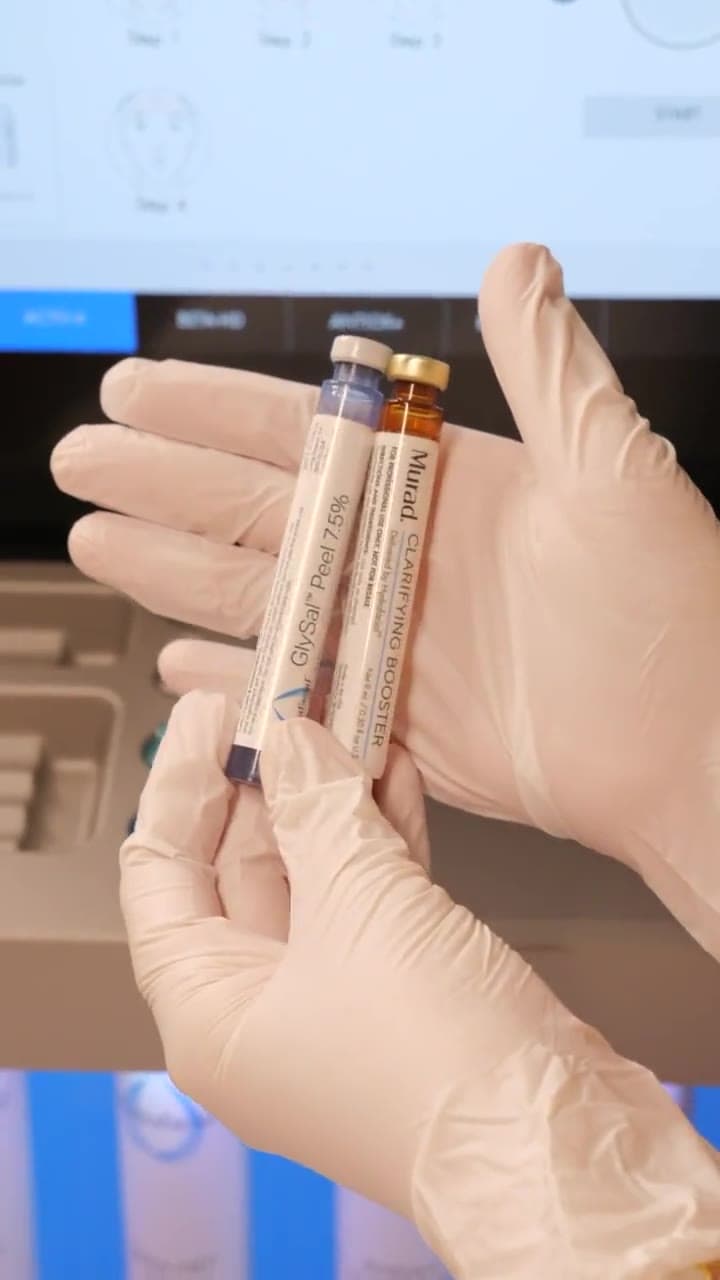
Two of our three HydraFacial tiers include a booster, and it is the single thing clients ask about least and benefit from most. Deluxe HydraFacial at $270 adds a customized booster serum and LED. Platinum HydraFacial at $320 carries an advanced booster on top of lymphatic drainage and the full treatment. Signature HydraFacial at $190 does not include one.
So what is it, and is it the part worth paying for? Here is the plain version of how boosters work on our menu, what each of our four directions is aimed at, and why we choose yours after we have looked at your skin rather than when you book.
The one-line version
A HydraFacial cleans, resurfaces, extracts and hydrates every face the same way. The booster is the step where the treatment stops being general and starts being about your skin. Our four directions are brightening, anti-aging, calming and clarifying, and they live on Deluxe HydraFacial ($270) and Platinum HydraFacial ($320).
The Short Answer
The core HydraFacial is a fixed sequence. The device cleanses, resurfaces, lifts congestion out with painless suction, and infuses hydrating serum - and it does that the same way on every face, which is precisely its strength. It is reliable because it does not improvise.
The booster is the one place where the treatment is tailored. Near the end of the sequence, a concentrated serum is infused into skin that has just been cleared and resurfaced, which is the most receptive it will be all month. Which serum we reach for is the decision that makes the appointment yours rather than generic.
That is also the honest frame for the price step between tiers. Going from $190 to $270 does not buy you a stronger treatment - the resurfacing is identical and so is the downtime, which is none. It buys targeting, plus the LED step. Our Signature vs Deluxe vs Platinum guide takes the whole tier decision apart.
What a Booster Actually Is
In HydraFacial's own breakdown of the protocol, the booster is one of seven steps - hydrate, microdermabrasion, peel, extract, booster, LED, and lymphatic drainage - and it sits deliberately after the extraction and resurfacing work is finished. The order is the point. A serum applied to congested, unexfoliated skin has to fight its way in; the same serum applied through Vortex-Fusion after that skin has been cleared meets far less resistance.
Practically, a booster is a single-use vial that goes into the device and is delivered during the treatment rather than smoothed on at the end. You will usually see it before it goes in - the vials are small, sealed, and labeled, and we are happy to show you which one we have picked and say why.
The Four Booster Directions
Our menu names four directions rather than four products, and that wording is deliberate: which specific vial we use depends on what is in the room and what your skin shows that day. What does not change is what each direction is for.
What we are not going to publish is an ingredient list per booster, and it is worth saying why. Boosters are stocked and reformulated by the manufacturer, our shelf changes, and a list printed on a blog in October is a promise we might not be able to keep in March. If the specific formula matters to you - allergies, pregnancy, a dermatologist's instruction - ask at your appointment and we will show you the vial and the label before anything goes on your skin.
Platinum HydraFacial carries what our menu calls an advanced booster, within the same four directions. It is not a fifth concern, and it is not a stronger treatment in the sense of more downtime - there is still none. It is the step up inside whichever direction your skin calls for.
Where the LED Step Fits
LED comes bundled with the booster on both Deluxe HydraFacial and Platinum HydraFacial, and it is a genuinely different mechanism rather than more serum. Our panel is the Elipsa by LightStim, a professional unit rather than a handheld. Per LightStim's own specifications it carries 868 professional-grade LEDs and emits blue, amber, light red, dark red and infrared wavelengths using patented MultiWave technology "to simultaneously emit multiple wavelengths (colors) of light." LightStim lists it as "FDA Cleared to reduce wrinkles on the entire face and to treat mild to moderate inflammatory acne."
Wavelength is what decides depth, and depth decides what the light can affect. Cleveland Clinic puts it simply: blue light "affects the uppermost layer of your skin," while "red light travels further into your skin." Blue "may destroy acne-causing bacteria"; red "may reduce inflammation and stimulate the production of collagen." In practice we rarely pick one color - the panel runs several at once, and we set it to match the booster direction we chose.
One caution deserves more attention than it usually gets, and it is the reason we ask rather than assume. The AAD notes that people with darker skin tones "are more sensitive to visible light, such as red light," and that resulting hyperpigmentation can be "more intense and long-lasting." Cleveland Clinic also advises caution for people taking medications that increase sun sensitivity, such as isotretinoin. Tell us either applies and we adjust the LED step - which is exactly the kind of thing a skin analysis exists to catch. The long version is in our LED light therapy guide.
How Your Booster Gets Chosen
Not at booking. At the start of your appointment, during the skin analysis that opens every treatment here and carries no consultation fee.
That is not a formality. Skin is a moving target - the same face can be congested in August and tight and reactive in January, and the booster that was right last visit can be the wrong call this one. Four things move the decision:
- What your skin is doing today, not what it usually does. Visible inflammation moves us toward calming even if you booked expecting brightening.
- What you have used this week. Retinoids, acids, a recent peel or a new prescription all change what your barrier can comfortably take.
- What you are actually trying to change, which is a conversation rather than an observation. Someone whose real goal is their wedding photographs gets different advice from someone managing long-term tone.
- What is going on medically. Pregnancy or nursing, active infection or an open breakout in the area, recent isotretinoin, a history of cold sores - all of it is worth telling us, because all of it changes what is sensible on the day.
If you have a strong preference, say so. We are describing how we arrive at a recommendation, not overruling you. But the recommendation is free and it comes from looking at your skin under proper light, which is more than a booking form can do.
If Your Main Concern Is X, Ask About Y
What a Booster Will Not Do
A booster is a surface step inside a surface treatment, and being straight about the ceiling is more useful than selling past it.
- It will not resurface a scar. Scarring sits below where any facial works. Microneedling is the treatment that reaches it - start with which microneedling is right for you.
- It will not erase deep lines or lift loose skin. That is collagen and volume work, and we do not offer injectables, lasers or radiofrequency.
- It will not treat a medical condition. Acne and rosacea are medical; a booster can calm and clear, but diagnosis and prescriptions come from a dermatologist. Esthetician vs dermatologist covers where that line sits.
- It will not outlast your routine. Surface results are temporary by design, which is why we talk about a rhythm of every 4 to 6 weeks rather than a one-off - see how often you should get a HydraFacial.
Booking in Plano
If you want a booster, you want Deluxe HydraFacial at $270 for 45 min or Platinum HydraFacial at $320 for 60 min. If you are not sure whether the targeting earns the step up from Signature HydraFacial at $190, book the Signature and ask at your analysis - we will tell you honestly, and are HydraFacials worth it answers the same question in writing.
Treatments are performed by founder and licensed esthetician Leila Razipoor, who is HydraFacial and microneedling certified, with clinical protocols overseen by our Medical Director, Dr. Brady Steineck, MD. Our clients have rated the studio 5.0 stars across 62 Google reviews. Browse the full treatment menu or get in touch, and we will start with the analysis.