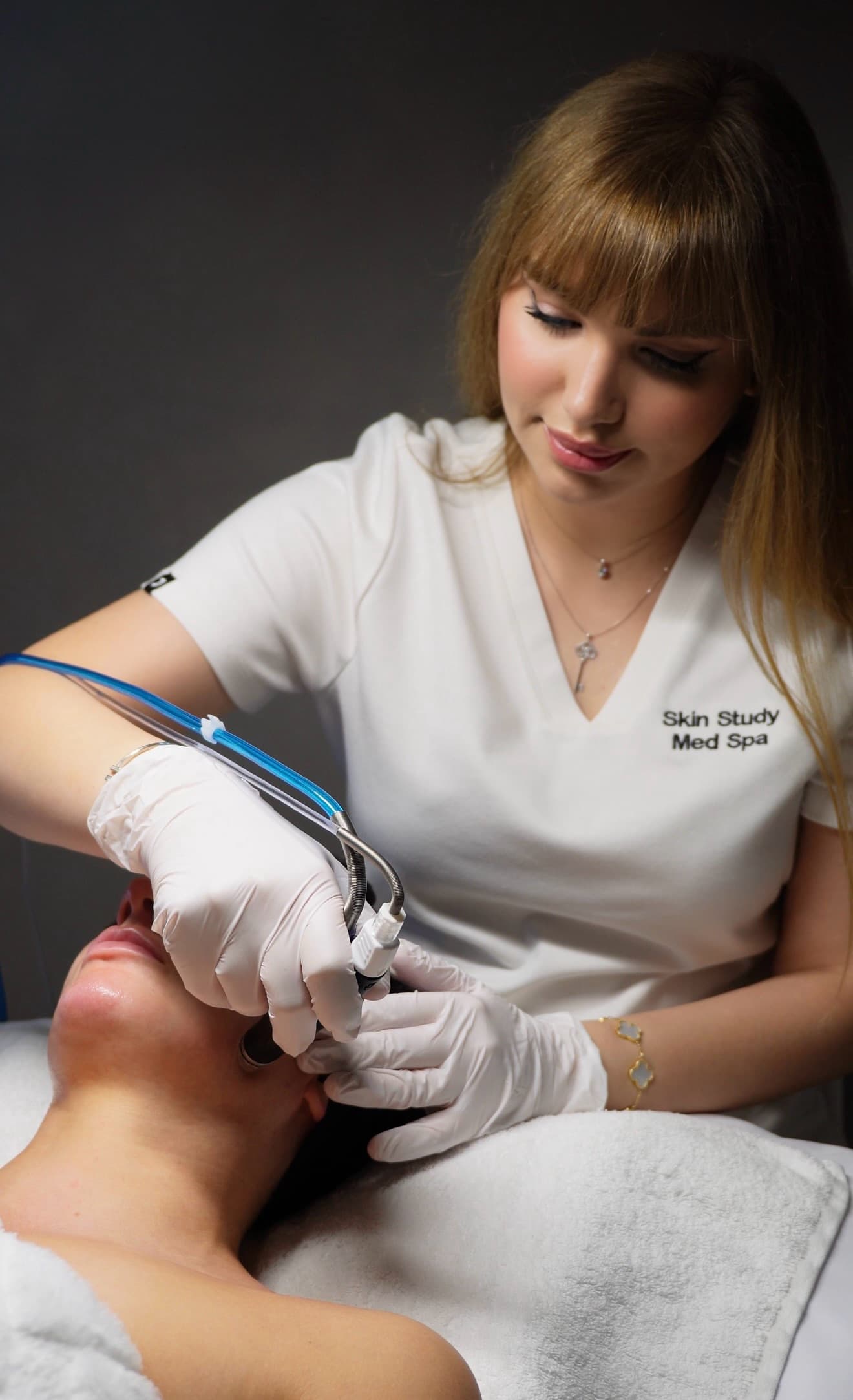
Microneedling is the one treatment on our menu with genuine downtime attached to it, which makes aftercare less of a footnote than it is for a facial. The needling takes an hour. The healing takes about a week - and almost all of it happens at home, where we are not there to stop you putting your usual serum on.
We are a small, esthetician-led studio in Plano, and every microneedling client leaves with written instructions. This page is the longer version of that handout: what the first day requires, what goes back in the cupboard for a week, what is a normal part of healing, and the short list of things that warrant a phone call. One caveat that matters - the instructions we hand you in person always take priority over anything here, because they are written for the depth we treated you at and the skin we treated.
The one-line version
For the first 24 hours: nothing on your face except the post-care we send home with you, no makeup, no sweating, no sun. Expect redness like a light sunburn for roughly 24 to 72 hours - the American Academy of Dermatology describes treated skin that "may feel like it's sunburned, causing minor discomfort, burning, or swelling," and notes those reactions "usually disappear in a few days to a week." Retinol and acids stay put away for about a week. Daily sunscreen starts as soon as your skin tolerates it and then does not stop.
The Short Answer
If you are reading this in the car after your appointment, this is the whole thing in seven lines:
- No makeup for 24 hours. The AAD is specific about this one: "it's important to wait 24 hours before you apply makeup."
- No sweating for 24 hours - no gym, no hot yoga, no sauna. Give it 48 if you are the kind of person who sweats through a spin class.
- No pools, hot tubs, steam rooms or lakes for a few days. This is an infection precaution, not a comfort one.
- Retinol, retinoids and exfoliating acids stay off for about a week, or until any flaking has finished.
- Cleanse gently with your fingertips and lukewarm water, then moisturize. Use only what we sent you home with for the first day.
- Do not pick, scrub or peel off flaking skin. Let it shed on its own schedule.
- Sun protection, properly, from here on. Day one is shade and a hat; sunscreen as soon as it does not sting.
If you booked SkinStylus Nanoneedling rather than microneedling, most of the above does not apply to you - skip ahead to the nanoneedling section.
The First Week, Day by Day
People tend to expect either nothing at all or a week of hiding. Neither is right. Here is the honest shape of it for a standard SkinStylus session, with the usual caveat that depth, skin type and how many sessions you have had all shift the edges.
The First 24 Hours Are the Ones That Matter
Microneedling works by controlled micro-injury: the device creates thousands of tiny channels that prompt your skin to rebuild collagen and elastin. That is also exactly why the restrictions are front-loaded. Until the surface has sealed over, anything you put on your face - or press into it with a brush - has a far easier route in than it does on an ordinary Tuesday. Our cost guide covers what the session itself involves; this is the other half of the deal.
The FDA's consumer guidance on microneedling devices sets out the expected effects plainly: "The damage may include bleeding, bruising, redness, tightness, itching and peeling, and these typically go away without any treatment after a few days or weeks." That is the normal course, and none of it needs treating. The same guidance lists the less common problems, and the pattern is instructive - "stinging or itching when cosmetics or other skin care products such as moisturizers and sunscreen are applied, dark or light spots on the skin, lines on the face, a flareup of cold sores, swollen lymph nodes, and infection." Three of those are things you can meaningfully reduce the odds of at home: product reactions, pigment changes and infection.
Makeup. Twenty-four hours, per the AAD, and the reason is not vanity about your result - it is that foundation brushes and sponges are rarely as clean as anyone would like, and the channels are open. If you have an event, book around it rather than cutting the window short.
Sweat and heat. Skip the workout for the first day. Sweat stings on treated skin, heat makes redness worse and last longer, and gym equipment is shared. The aftercare guidance published by the American Med Spa Association puts it at "the first 24-48 hours" for "any activity that could lead to excessive sweating" - we say 24 as the floor and 48 if your exercise is strenuous.
Water you share with other people. Pools, hot tubs, steam rooms, lakes and the ocean wait a few days. The same trade guidance advises avoiding "swimming, saunas, and steam rooms for a few days post-treatment to prevent bacterial infections," and that is the honest reason - chlorine and warm standing water are not a good match for a skin barrier that is still closing.
Your hands. Do not test the texture, do not pick at flakes, do not lift a scab. If you do nothing else on this list well, do this one.
What to Pause, and for How Long
This is where most people go wrong, and almost always with good intentions - reaching for the strongest thing in the cabinet because the skin looks like it needs help. It does not. It needs to be left largely alone and kept moist.
What you should be using is short: a mild cleanser, a bland moisturizer, and whatever post-care we sent you home with. The AAD notes that "your dermatologist may recommend applying a post-treatment aftercare cream" - ours is chosen to suit the serum we infused, which for our growth-factor and exosome tiers is an AnteAGE product. That is the one case where the thing we hand you is better than the thing in your cupboard.
Sun Protection Is the Long Game
If aftercare has a single highest-value habit, it is this one, and it runs long after the week is over. The AAD lists sun protection on both ends of microneedling - before treatment, "you'll also need to protect your skin from the sun," and afterward, to hold onto the result, "protect your skin from the sun." The stake is specific rather than vague: the FDA's less common effects include "dark or light spots on the skin," and freshly treated skin exposed to UV is exactly how post-treatment pigment change happens. That risk is higher, not lower, on deeper skin tones.
There is an honest wrinkle in the advice, though. On day one, sunscreen may well sting - the FDA names that reaction specifically. So we do not tell people to force it onto raw skin on the first afternoon. Day one is shade, a wide hat, and staying out of the sun altogether. From the point sunscreen is comfortable, usually day two, it becomes non-negotiable.
The AAD's sunscreen specification is worth following properly, since most people under-apply by a wide margin: choose a sunscreen "that has an SPF of 30 or higher, is water resistant, and provides broad-spectrum (UVA and UVB rays) coverage." For a face, the Academy's measure is "at least 1 teaspoon (about the amount needed to cover the length of your index and middle fingers)," applied before you go out because "it takes approximately 15 minutes for your skin to absorb the sunscreen," then reapplied "every two hours, and immediately after swimming or sweating." A mineral formula with zinc oxide or titanium dioxide tends to be the comfortable choice in the first week.
If You Booked Nanoneedling, Most of This Is Not for You
SkinStylus Nanoneedling ($150, 60 minutes) is a different proposition and has a different aftercare. It creates microscopic channels in the outermost layer to drive serum absorption without injuring the skin - no numbing cream, essentially no downtime. The FDA draws the category line in a useful way: a microneedling product that "does not have longer needles or sharp needles that penetrate the skin and only claims to facilitate exfoliation of the skin or improve the appearance of skin" is not regulated as a medical device at all. That is the difference between the two services in one sentence.
Practically: you can wear makeup the same day, go to the gym, and carry on as normal. We would still skip strong actives for a day or two and wear sunscreen, because exfoliation is exfoliation. It is the option we recommend when someone wants glow before an event and cannot spare the redness - our wedding prep timeline covers how to sequence that properly.
Normal, or Worth a Call?
The useful mental model: discomfort and redness should trend down every day. Anything that gets worse after day two is the thing to pay attention to.
One screening point belongs here rather than in the small print, because it is about how you heal: the AAD advises against microneedling if you "heal slowly or poorly," have or have had "a raised scar called a keloid," or "have a weakened immune system due to a medical condition or medication." We ask about all three before we treat, and we would rather hear about a medication than find out afterward. And to be clear about the limits of our room - we read and treat skin, we do not diagnose. If something looks like it needs a prescription, that is a doctor's call, and our guide to that line explains where it sits in Texas.
Worth Knowing: We Do Not Use RF Microneedling
Two quite different treatments get sold under the microneedling name, and aftercare you read online may well be for the other one. Ours is mechanical: the SkinStylus system, needles only, no energy. Radiofrequency microneedling sends RF energy through the needles to heat the deeper layers, and it is a materially different procedure with a different risk profile.
That distinction is not academic. On October 15, 2025 the FDA issued a safety communication about "serious complications (adverse events) including burns, scarring, fat loss, disfigurement, and nerve damage" reported with certain uses of RF microneedling devices, and stated that "RF microneedling is a medical procedure, not a cosmetic treatment, and these devices should not be used at home." We do not own one and do not offer it, so if RF is what you are after we are not your studio. The device we do use is, per SkinStylus, "the ONLY microneedling device with FDA clearance for use on both face and abdomen," with cartridge configurations "all cleared to 2.5mm."
Who holds the device matters for your healing too, and both bodies say so. The FDA's guidance is to "choose a health care provider who is specially trained in microneedling," and the AAD warns that where it is performed by someone lacking that training there is "an increased risk of developing side effects like infection, scarring, or long-lasting skin discoloration." The AAD's own recommendation is a board-certified dermatologist. Here, microneedling is performed by founder and licensed esthetician Leila Razipoor, and our clinical protocols are overseen by our Medical Director, Dr. Brady Steineck, MD. That is the honest version of our credentials - not a dermatology practice, and not someone who learned the device at a weekend course.
When the Results Actually Arrive
Aftercare is easier to stick to if you know what you are protecting, and the timeline is slower than the marketing suggests. The week-two glow is real, but a good part of it is hydration and plumping. The structural work - new collagen in the dermis - is the slow half, and it does not show up on a schedule that suits anybody's calendar.
The AAD's framing is the one we use with clients: "you may see improvement within a few weeks," and "it usually takes several months before you see full results." For scarring specifically, the Academy notes that "if your dermatologist is treating acne scars, you may need 3 to 5 treatments, which are performed every 2 to 4 weeks." That is why we talk about a series rather than a session, and why the 2-to-4-week gap between appointments is not us being awkward about scheduling - it is the remodeling window. Our acne scar guide sets out which scar types respond, and microneedling versus a chemical peel covers the choice between the two routes.
The flip side is that a single session with careless aftercare is a worse spend than no session at all. Sun exposure on week-one skin, retinol on day three, or a picked scab can each cost you the result you paid $300 to $600 for - see the full cost breakdown for what each tier includes.
Booking Microneedling in Plano
Our microneedling menu runs from SkinStylus Nanoneedling at $150 (no downtime) through the SkinStylus Original at $300, a brightening growth-factor serum at $400, brightening exosomes at $500, and the AnteAGE P.E.A.R.L exosome system at $600. Numbing cream, your post-care products and written aftercare instructions are part of every microneedling appointment, not an upsell.
Every appointment opens with a professional skin analysis, which is also where we decide depth and therefore how much downtime you should plan for - our methodology page explains how that works. If you have an event, a vacation or a swim meet in the next two weeks, say so at that point and we will time the series around it.
Treatments are performed by founder and licensed esthetician Leila Razipoor, with clinical protocols overseen by our Medical Director, Dr. Brady Steineck, MD. Our clients have rated the studio 5.0 stars across 62 Google reviews. Browse the full treatment menu, check the price list, or get in touch and we will start with the analysis.