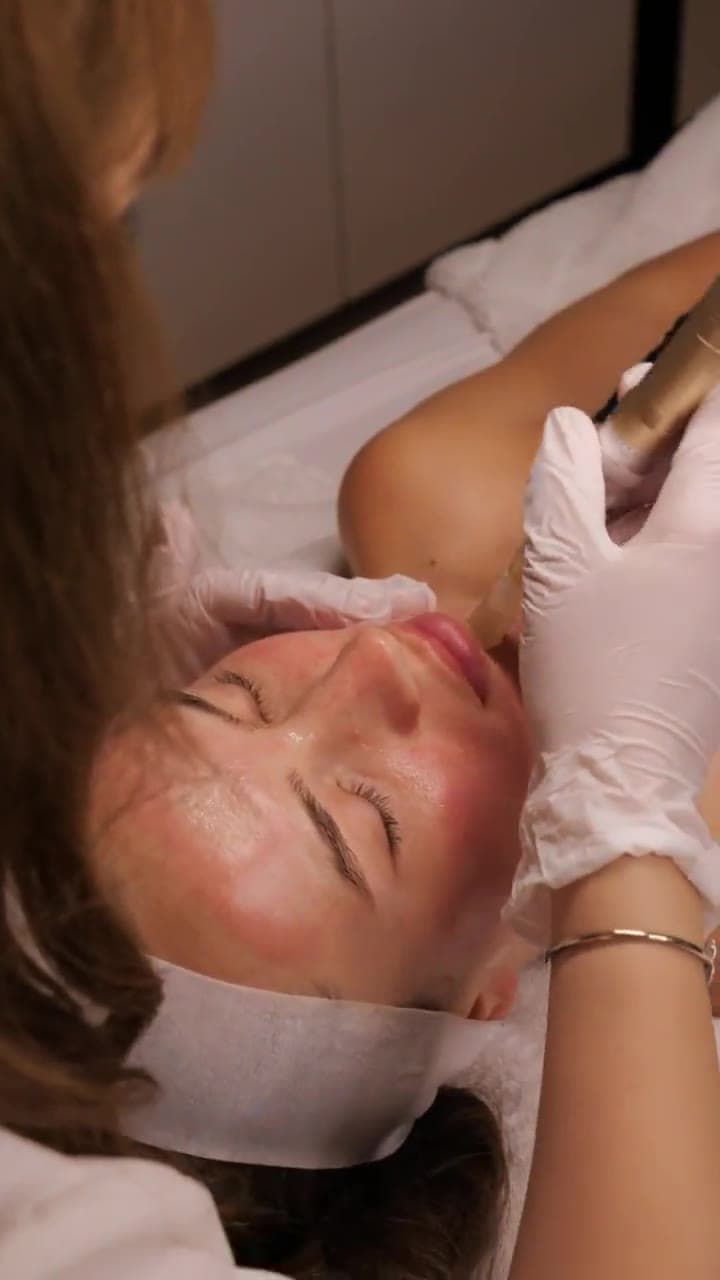
If you have been pricing microneedling around Dallas, you have run into two upgrades sold as the thing that makes it work: platelet-rich plasma, usually called PRP or the vampire facial, and exosomes. Both are presented as the premium tier. Both carry a real price jump. Very few pages explain what either one actually is.
We offer microneedling with AnteAGE exosomes and we do not offer PRP, so you should read what follows knowing that. We have tried to write the version we would want to read if we were the one deciding - including the parts that do not flatter our own menu.
The one-line version
Neither add-on is the treatment. The needling is. PRP is your own blood, spun down and applied after the needling - a medical procedure that needs a blood draw, which is why a med spa esthetician cannot perform it. Exosomes are a topical serum applied the same way, with no FDA-approved exosome product on the market. For acne scarring specifically, PRP is the option with published support behind it, and we will tell you that rather than talk you into a serum.
The Short Answer
If your main concern is acne scarring and you want the combination with the most evidence behind it, that is microneedling with PRP, and you want a board-certified dermatologist or a medical provider who draws blood. We do not offer it and we will say so plainly at your consultation.
If your concern is texture, tone, fine lines, or overall skin quality, the honest picture is that the needling is doing the heavy lifting either way, and the add-on is a smaller variable than the price difference suggests. That is the case where our exosome tiers make sense: you are paying for a more supportive finish on a procedure that works on its own.
What nobody should tell you is that one of these serums is the difference between a result and no result. Neither is.
The Needling Is the Treatment
Microneedling is, in the American Academy of Dermatology's words, "a medical treatment that uses tiny needles to puncture the skin" in order to diminish acne scars, large pores, uneven texture, and fine lines. The punctures trigger your own wound-healing response, and the result is new collagen in the treated area. That mechanism is the product. It happens whether or not anything is layered on top.
The AAD is specific about what a course looks like: for acne scars "you may need 3 to 5 treatments, which are performed every 2 to 4 weeks," and studies show such a plan "can fade acne scars by 50% to 70%." Results "appear gradually as your body produces collagen" - some improvement within a few weeks, but "it usually takes several months before you see full results."
Read those numbers again before you shop add-ons. The 50% to 70% figure is attached to the needling protocol, not to a serum. Our own microneedling cost guide prices the same 3-to-5 session reality, and our SkinStylus Original at $300 is that protocol with a hyaluronic acid booster and nothing exotic on top.
What PRP Actually Is
PRP is made from you. Per the AAD, it is "3-step procedure that involves having your blood: Drawn from your arm, Placed into a machine that separates the platelets from the rest of your blood, Re-injected into you." Paired with microneedling, your blood is drawn and spun in a centrifuge while the needling is performed, and the platelet-rich portion is then applied to the treated skin.
That autologous quality is PRP's genuine advantage. It is your own platelets, so there is no question of what is in the vial or who made it. The AAD notes there is "little to no downtime," though you may have "a bit of pain, bruising, and swelling afterwards," which "tend to go away within a few days."
It is not for everyone. The AAD lists conditions that rule it out, including "Hepatitis C, HIV or AIDS, Any type of blood cancer, Cardiovascular disease, which requires taking a blood thinner," and "Skin cancer in the area to be treated." And on timing, as with the needling itself, "if you get results, the full effects appear within a few weeks to months," with most patients needing "3 or more treatments."
What Exosomes Actually Are
Exosomes are tiny vesicles that cells use to signal to one another. In skincare they arrive as a manufactured topical serum, applied to the skin immediately after needling while the micro-channels are open. We use the AnteAGE line, including the P.E.A.R.L system on our top tier, and the manufacturer's position is that these support repair, hydration, and collagen renewal.
Here is the part you should know, and that most med spa pages selling exosomes do not print. The FDA's consumer alert on regenerative medicine products states that "exosome products are also regulated by FDA" and that, as a general matter, those "intended to treat diseases or conditions in humans require FDA approval." It then says plainly: "There are currently no FDA-approved exosome products."
What that does and does not mean
The FDA's alert is aimed at unapproved products marketed to treat diseases - injected and infused biologics sold as cures. What we apply is a cosmetic topical serum placed on the skin surface after needling. We do not inject anything, and we do not claim it treats any disease or condition. We are telling you the regulatory status because you should hear it from us rather than find it later, and because any provider who sells you exosomes as a proven medical therapy is overselling.
Microneedling With Exosomes vs PRP, Side by Side
What the Evidence Actually Supports
On microneedling with PRP, the AAD is direct: "using both of these treatments can improve your body's ability to make collagen," and the combination "can be especially effective for fading acne scars." That is a reasonable endorsement of a specific pairing for a specific problem.
But the same organization is unsentimental about PRP's broader reputation. On its use for younger-looking skin generally, the AAD writes that "all these benefits have created high demand for a procedure that has little evidence to back it up," and that few studies have been conducted. So PRP is better supported than exosomes for acne scarring, and still thinner than its marketing suggests for everything else.
For exosomes, there is no comparable body of published work to point you to, and we are not going to manufacture one. What we can tell you honestly is what the product is, what the manufacturer claims, what the regulatory position is, and what we observe: clients on the exosome tiers tend to report a calmer, faster-settling recovery. That is an observation from our treatment room, not a clinical finding, and we would rather label it that way than dress it up.
One more thing worth hearing, since we are quoting the AAD on everything else: for microneedling it recommends "seeing a medical doctor who has expertise in treating the skin and performing cosmetic treatments, such as a board-certified dermatologist." At our studio the treatment is performed by a licensed esthetician with clinical protocols overseen by our Medical Director. Where that line sits in Texas, and when a doctor is genuinely the right call, is covered in esthetician vs dermatologist.
Why We Offer One and Not the Other
It is not a judgment about PRP. It is scope. PRP requires drawing blood from your arm and returning it to your skin, and that is a medical act - outside what a Texas esthetician license authorizes, regardless of how good the result might be. A med spa that performs PRP does it through a physician, PA, or nurse practitioner.
Exosome serums sit on the cosmetic side of that line: a topical applied after needling, within scope, which is why they appear on our menu and PRP does not. If PRP is what your skin calls for, the right outcome of your consultation here is a referral, not an upsell into a $600 tier.
How to Choose
Booking in Plano
Every microneedling appointment here starts with a skin analysis, and that is where this gets decided properly - including the possibility that the answer is a referral or that a chemical peel is the better instrument for what you actually have. If you are weighing the two, the microneedling vs chemical peel comparison is the longer version of that conversation.
Treatments are performed by founder and licensed esthetician Leila Razipoor, who is microneedling and HydraFacial certified and trained at Collin College, with clinical protocols overseen by our Medical Director, Dr. Brady Steineck, MD - our methodology page explains how that works. Our clients have rated the studio 5.0 stars across 62 Google reviews, and pages like this one are a fair part of why. Browse the full treatment menu, see the price list, or get in touch and we will start with the analysis.