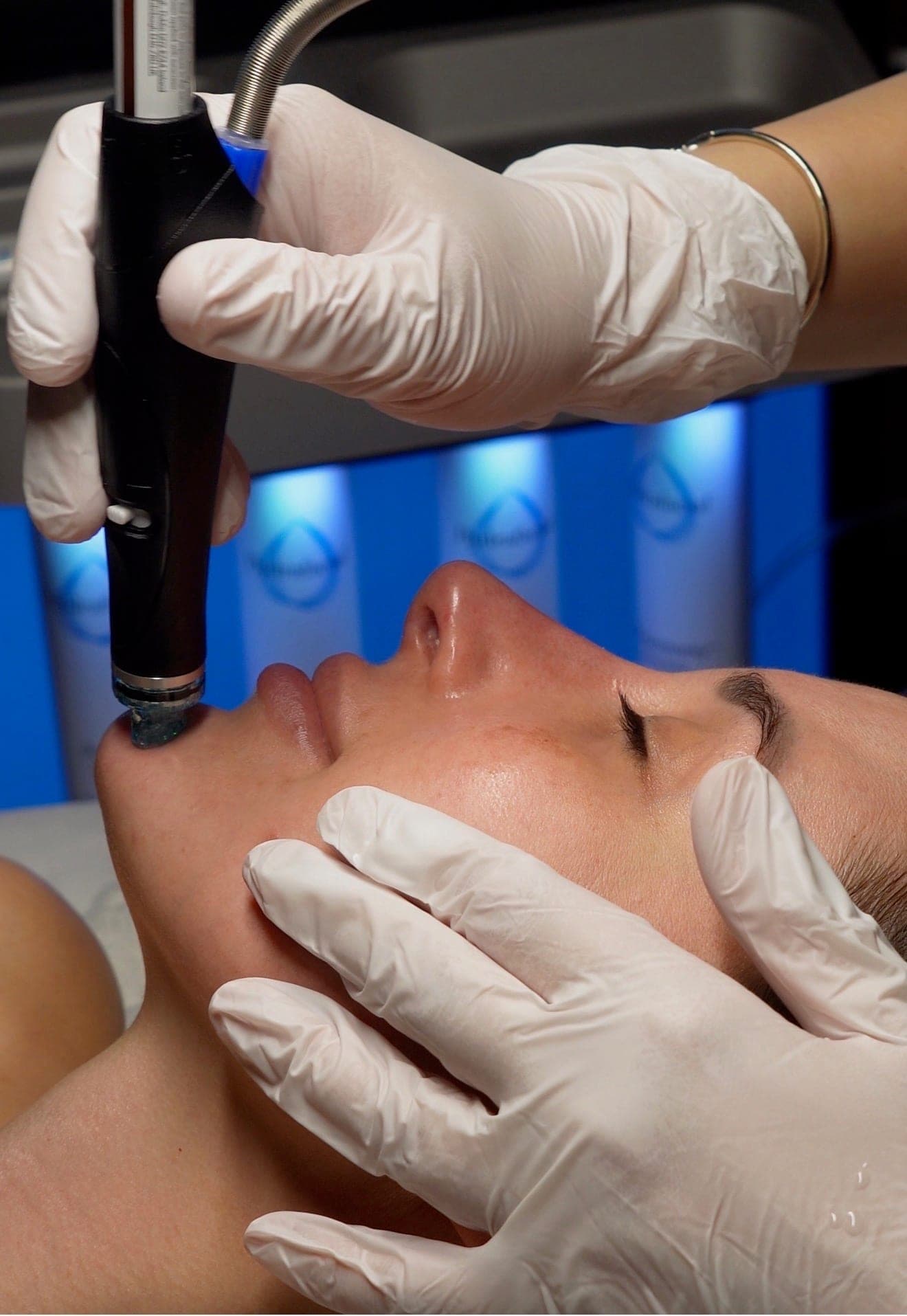
"Is a HydraFacial good for acne?" is one of the two or three questions we are asked most often, and the honest answer depends entirely on what is actually on your face when you ask it. The word "acne" covers a blackhead and a deep cyst, and those are not the same problem, do not have the same cause, and absolutely do not have the same answer.
So rather than give you the brochure version, this page goes lesion by lesion: what a HydraFacial does for each kind of breakout, which tier is worth paying for if acne is why you are booking, when we would ask you to postpone, and where the treatment sits inside a plan that also involves a dermatologist. Prices below are our real menu prices in Plano.
The one-line version
A HydraFacial is strong on clogged pores and weak on inflamed acne. It clears comedonal congestion - blackheads, closed comedones, the general grittiness that becomes next month's breakout - comfortably and with no downtime. It does not treat papules, pustules, nodules or cysts, and it is not acne medicine. If your skin is actively inflamed, the Acne Treatment Facial ($200) is usually the better room, and anything deep and painful belongs with a dermatologist first.
The Short Answer
If your skin is congested but calm - visible blackheads, a rough-feeling T-zone, pores that refill a week after you clear them - a HydraFacial is a genuinely good fit, and the extraction step is the reason. If your skin is actively breaking out in red, sore, raised lesions, a fixed resurfacing sequence run over inflamed skin is not what we would choose for you, and we will say so rather than take the booking.
That distinction - congested versus inflamed - does more work than any tier or booster decision on this page, and it is the one most people have never had explained to them. Everything below is an elaboration of it.
Which Breakouts It Helps, Lesion by Lesion
The American Academy of Dermatology sorts acne by lesion type, and its guidance differs sharply from one type to the next. We have mapped our treatment against its categories rather than against the marketing word "acne," because that is the only way the answer stays honest.
Read down that table and the pattern is obvious: everything a HydraFacial helps lives in the pore, and everything it does not help lives in the inflammation. That is not a limitation we are apologizing for - it is a device that clears and hydrates, used well, within what it does.
What the Extraction Step Actually Does
The HydraFacial handpiece uses what the manufacturer calls "patented Vortex-Fusion® technology to cleanse, exfoliate, extract and hydrate the skin in one continuous treatment." Of the brand's seven steps, the one that matters for congestion is extraction, and HydraFacial describes it in six words: it "clears pores without discomfort or visible redness."
Mechanically that is gentle vortex suction applied to skin that has already been softened by the cleanse, the exfoliation tip and a resurfacing step. Debris comes up out of the pore rather than being squeezed out of it. There are no fingers, no comedone extractor and no pressure applied to a lesion, which is why the step is comfortable and why it does not leave the blotchy post-extraction look a traditional deep-cleansing facial sometimes does.
This is not the procedure the AAD calls "acne extraction"
Worth being precise, because the words collide. The AAD uses acne extraction to mean a medical procedure in which "your dermatologist physically removes acne breakouts" - and it states that this "should only be performed by a board-certified doctor." That is not what happens here, and we would not claim otherwise. Our extraction step is suction clearing the contents of pores. It does not address an individual inflamed lesion, and nobody at this studio will press on one.
If you have been squeezing things yourself in the meantime, the AAD's acne skin care guidance is worth reading before your appointment: picking slows healing and raises the risk of scarring and of the dark marks it calls post-inflammatory hyperpigmentation. Most of what we end up treating months later started as something that was picked.
The One Step With an Acne Clearance
Here is the part of the HydraFacial-for-acne conversation that actually has a regulatory clearance behind it, and it is not the device most people assume.
The LED step included on our Deluxe HydraFacial and Platinum HydraFacial tiers uses the Elipsa by LightStim. Per LightStim's own product specifications it carries "868 total medical-grade LEDs" emitting "Blue 410nm, Amber 612nm, Light Red 645nm, Dark Red 655nm, Infrared 850nm" through the company's patented MultiWave technology - and LightStim states the panel is "FDA Cleared to reduce wrinkles on the entire face and to treat mild to moderate inflammatory acne."
That clearance is real and it is specific: mild to moderate inflammatory acne. It is not a clearance for severe acne, for nodules or for cysts. And the improvement figures LightStim publishes come from "clinical studies performed using LightStim handheld devices" rather than from the Elipsa panel itself, which is why we quote you no percentage. HydraFacial's own description of its LED step is similarly measured - blue light "helps target breakout-causing bacteria and calm visible inflammation."
The practical consequence: if acne is why you are booking, the LED step is the single strongest argument for paying past Signature HydraFacial. Our longer guide to LED light therapy covers the wavelengths and what each is for.
Which Tier to Book for Acne
Our three tiers are on the HydraFacial menu and the full tier decision lives in Signature vs Deluxe vs Platinum. This is the acne-specific slice of it.
Which booster you get is settled in the room, not at the booking screen - HydraFacial boosters explained walks through the four directions and how yours is chosen. HydraFacial's own copy lists "congestion" among the concerns the boosters target, which is the right word for it: congestion, not acne.
Timing It Around a Flare
Acne is not a steady state, and the same skin can be a good candidate one month and a poor one the next. A few rules we actually follow:
- Mid-flare, we would rather wait. If the skin is red, sore and raised today, a resurfacing sequence over it is likely to leave it more irritated than it started. We will offer you something calming instead, or ask you to come back.
- Between flares is the window. A HydraFacial does its best work on skin that is settled, clearing the congestion before it becomes the next round of breakouts. That is maintenance, and it is a legitimate reason to book monthly.
- Before an event, do not experiment. If you are breaking out and an event is close, that is the worst moment to try a treatment your skin has never had. Our skin prep timeline covers how far ahead to book - the short version is further ahead than you think.
- Tell us about your prescriptions. Isotretinoin, a prescription retinoid, a topical antibiotic, spironolactone - all of it changes what is sensible on the day, and some of it changes whether we treat at all. Bring the names to your skin analysis; if there is any question, the call belongs to your prescriber and we will wait for it.
- Give any plan six to eight weeks. That is the AAD's own timeframe before judging an acne treatment, and it applies to the skincare you go home with as much as to anything we do in the room.
What Actually Treats Acne
We would rather you read this here than work it out after spending money. Acne is a medical condition, and the treatments with evidence behind them are, per the AAD's diagnosis and treatment page, overwhelmingly medications:
- Retinoids - "This medication works to clear your pores, and can treat blackheads, whiteheads, and some pimples."
- Benzoyl peroxide - "This active ingredient reduces acne-causing bacteria on your skin."
- Topical and oral antibiotics - prescribed, the AAD notes, "for the shortest time, usually several months, needed to treat acne."
- Isotretinoin - which dermatologists "prescribe ... to treat nodular acne that hasn't responded to other acne treatments."
- Hormonal therapy - combined oral contraceptives, spironolactone for "women who have stubborn hormonal acne," and clascoterone, "the first FDA-approved medication that can treat the hormonal causes of acne in both males and females."
Not one of those is a facial, and not one of them is available here. A licensed esthetician cannot diagnose and cannot prescribe - esthetician vs dermatologist covers exactly where that line sits in Texas. What we can do is the part that sits alongside the medicine: keep pores clear, keep the barrier intact, and keep the skin comfortable while a prescription does the heavy lifting.
The one procedure on the AAD's list that we do offer is the chemical peel - the Academy writes that "when applied to acne, a chemical peel helps remove dead skin cells that are clogging your pores and excess oil." Ours are covered in chemical peel for acne, and for congested or oily skin a peel series frequently outperforms a monthly HydraFacial on the same budget.
Where a HydraFacial Fits in a Real Plan
Almost nobody with acne needs one treatment. They need an order of operations. This is the one we use, with our real prices:
If you want the three-concern view rather than the acne-only one, best facial for acne, rosacea and hyperpigmentation is the overview page, and HydraFacial benefits by skin type covers what the treatment does for oily, dry, mature and sensitive skin alongside acne-prone.
The Marks and Scars Left Behind
Two different things get called "acne scars," and a HydraFacial addresses neither of them well, so it is worth separating them.
Post-inflammatory marks are flat - brown or red patches where a breakout used to be. They are a pigment and inflammation problem, they fade on their own over months, and peels can speed that up. True scars are textural - the skin's surface is physically depressed or raised because tissue was damaged. Nothing applied to the surface fixes those; they need something that works below it.
How to get rid of acne scars works through the full option set, including the treatments we do not offer and refer out. The relevant point for this page is simply that no HydraFacial, at any tier, is a scar treatment, and we will tell you that before you book rather than after.
Booking a HydraFacial for Acne in Plano
The practical route: book Deluxe HydraFacial ($270, 45 min) if your skin is congested but settled, and tell us at booking that acne is why you are coming - it changes the booster, the LED and how we handle the extraction step. If you are flaring, say so and we will steer you to the Acne Treatment Facial instead. Either way the appointment opens with a skin analysis, and if the honest answer that day is "a dermatologist first," that is what you will hear.
Treatments are performed by founder and licensed esthetician Leila Razipoor, who is HydraFacial and microneedling certified, with clinical protocols overseen by our Medical Director, Dr. Brady Steineck, MD. Our clients have rated the studio 5.0 stars across 68 Google reviews. Browse the full treatment menu or get in touch.
Frequently Asked Questions
Keep exploring