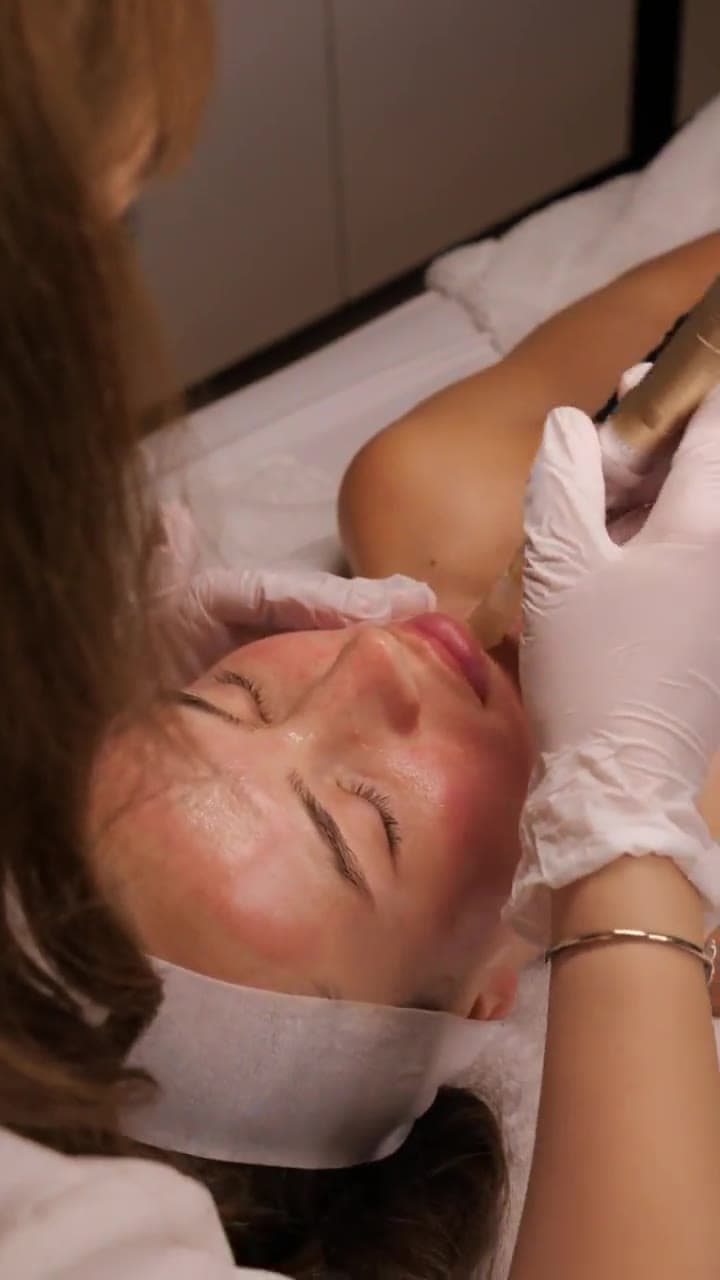
Acne scarring is the single most common reason people book microneedling with us, and it is also the concern where expectations and reality drift furthest apart. Microneedling genuinely works on scarring. It works on some shapes of scarring far better than others, it works slowly, and it works as a course rather than a session.
This guide is specifically about what microneedling does for scars. If you are still at the stage of working out whether what you have is a scar at all, start with how to get rid of acne scars, which covers the scar-versus-dark-spot question and the full set of professional options. If you are choosing between two treatments, microneedling vs chemical peel for acne scars is the head-to-head. We will not repeat either here.
The one-line version
Microneedling suits depressed acne scarring, and shallow-and-wide responds better than narrow-and-deep. The American Academy of Dermatology notes you may need 3 to 5 treatments, every 2 to 4 weeks, and that studies show such a plan can fade acne scars by 50% to 70%. Start with the SkinStylus Microneedling (Original) at $300; the exosome tiers add support, not a shortcut.
The Short Answer
A depressed acne scar is, in the AAD's words, what forms when "your skin makes too little collagen to fill the area where the acne was." Microneedling addresses that directly: controlled micro-channels trigger your own wound-healing response, and the response lays down new collagen in the treated area. You are not filling a scar from outside. You are prompting the tissue to do the filling it failed to do the first time.
That mechanism is why the treatment is well matched to acne scarring and why it is slow. It is also why depth matters so much - a resurfacing pass can reach a shallow depression far more effectively than a narrow tract running deep.
Which Scarring Responds Best
The AAD's guide to the signs and symptoms of acne scars names three depressed shapes, and they do not respond equally.
Most people have a mixture, which is normal and is why we treat the face rather than individual marks. It also means a realistic plan often improves the overall surface noticeably while leaving the deepest individual scars still visible - and we would rather tell you that in advance than have you count them afterward.
How Much Improvement Is Realistic
Here the AAD gives a number, which is rare and useful. For acne scars treated with microneedling, "studies show that microneedling can fade acne scars by 50% to 70%" when performed as a course of 3 to 5 treatments every 2 to 4 weeks.
Read that carefully, because it is doing a lot of work. Fade, not erase. A course, not a session. And that figure belongs to the needling protocol itself rather than to any serum layered on top of it - a point worth holding onto when a menu offers you four price points.
We are not going to improve on the AAD's range with a number of our own, and nobody showing you a percentage for their specific serum can support it. What we can tell you is that the people who get the most out of this are the ones who complete the course and protect the result from the sun afterward.
What a Course Looks Like
Three to five sessions, two to four weeks apart, is the plan we work from for scarring. The gap is the collagen remodeling window - treating sooner means treating skin that is still finishing the last round, which buys irritation rather than collagen.
On timing, the AAD sets expectations plainly: results "appear gradually as your body produces collagen," you "may see improvement within a few weeks," and "it usually takes several months before you see full results." In practice the change most people first notice is not the scars themselves but the surface around them - texture evening out, light falling more smoothly on the cheek. The scars follow.
Your actual number of sessions gets confirmed at your skin analysis and revisited as we go, because how you heal from the first session tells us more than anything we can judge in advance. The pacing question in general is covered in how many microneedling sessions you need.
Which Tier to Consider
Our microneedling menu has four tiers, and the needling is identical across all four - same device, same appointment, same depth decision. What changes is what is infused into the open channels afterward. For scarring specifically:
The advice we give most often: choose the tier you can repeat three to five times. A course at $300 is $900 to $1,500 and will do more for your scarring than one session at $600. If budget allows the upgrades across a full series, the exosome tiers add genuine support to the repair process - they do not replace the need for the series. The tiers are compared properly in which microneedling is right for you, and PEARL has its own explainer.
What Microneedling Will Not Do
The short list, so nothing here is a surprise at your appointment:
- It will not erase scarring. The AAD's own range is a 50% to 70% fade across a course, and that is the honest ceiling to plan around.
- It will not fix ice pick scars. Narrow and deep is not reachable from the surface, and that is a physician's procedure.
- It will not treat active acne. Microneedling addresses the marks acne leaves behind. If breakouts are still active, that usually comes first - our Acne Treatment Facial is built for congestion and inflammation, and persistent or cystic acne is a conversation with a physician.
- It will not fade a flat dark mark faster than the pigment routes will. Post-inflammatory pigment responds to sun protection, the right topicals and often a peel.
- It will not hold its result without sunscreen. Freshly remodeled skin plus UV is how you trade a scar for a pigment problem.
And one line about our room: we read and treat skin, we do not diagnose. If what you have needs a prescription or a procedure we do not perform, we will say so - esthetician vs dermatologist sets out where that line sits in Texas.
The Visit, and the Week After
Every appointment opens with a skin analysis, which for scarring means looking at your skin in raking light and touching it, because a flat mark vanishes at an angle while a true depression casts a shadow. That is also where we screen: prescription medications including isotretinoin and retinoids, recent waxing, lasers or peels elsewhere, a history of cold sores, pregnancy or nursing, and anything active on the skin. The AAD additionally advises against microneedling if you heal slowly or poorly, have had a keloid scar, or have a weakened immune system due to a medical condition or medication.
Numbing cream goes on first, so the treatment is comfortable. Afterward, expect redness like a light sunburn for roughly 24 to 72 hours, with light flaking possible later in the week. The step-by-step of a first visit is in what happens at a first microneedling appointment, and the week afterward - which genuinely affects your result - is covered in microneedling aftercare.
Booking in Plano
Microneedling for acne scars starts at $300 with the SkinStylus Microneedling (Original), with growth-factor and exosome upgrades at $400, $500 and $600. SkinStylus Nanoneedling at $150 is on the same menu but is not a scar treatment - it works in the outer layer only. Everything is on the published price list, and the skin analysis is part of the appointment rather than a separate fee.
Treatments are performed by founder and licensed esthetician Leila Razipoor, with clinical protocols overseen by our Medical Director, Dr. Brady Steineck, MD. Our clients have rated the studio 5.0 stars across 62 Google reviews. Get in touch and we will look at what you actually have before we tell you what it will take.
Frequently Asked Questions
Keep exploring