It is the question underneath every other microneedling question we get asked in Plano - the price, the sessions, the downtime, the serum upgrades. Does the needle actually build collagen, or is that a phrase the industry says because it sounds like science?
It does. But the mechanism matters more than the yes, because the mechanism is what explains the two things people find hardest about this treatment: why nothing much happens in the first fortnight, and why one appointment is not a plan.
The one-line version
Microneedling does not put collagen into your skin - no treatment on any menu anywhere does that. It creates controlled micro-injuries so your own skin repairs them, and the repair material is collagen. The American Academy of Dermatology puts it in eight words: it "works by stimulating your body to make collagen." You are buying a signal, not a substance, which is exactly why the results take months and why they fade if you stop protecting them.
The Short Answer
Yes - microneedling builds collagen, and it is the only treatment on our menu that does it by design. The AAD describes the process plainly: "When properly performed, your body responds by healing the holes in your skin with just the right amount of collagen." Note both halves of that sentence. Properly performed is doing work in it, and so is just the right amount - this is a calibrated injury, not a maximal one.
What follows is the honest version: what collagen is, why you are losing it, what actually happens after the needle, what the one good histology study measured in real biopsies, and the short list of things sold as collagen builders that are not. If you only want to know how many appointments and how far apart, that is a different page - how many microneedling sessions you need covers the schedule and this page covers the reason there is one.
What Collagen Actually Is
Collagen is structure. Per Cleveland Clinic it is "the most abundant protein in your body," and "some 28 types of collagen types have been identified." The one that matters for this conversation is type I, which "makes up 90% of your body's collagen" and is densely packed to give support to skin, bone, tendon and ligament tissue.
The practical translation for a face: collagen is the scaffolding sitting underneath what you can see. When it thins, the surface above it has less to rest on - lines hold their crease instead of relaxing, texture reads rougher in side light, and a depressed acne scar stays depressed because the floor of it never rebuilt. That is why a product applied on top can change how skin looks and feels without changing any of it. It is working above the layer where the problem is.
Your body also needs raw materials. Cleveland Clinic names them: "the main amino acids that make collagen are proline, glycine and hydroxyproline," and the body "also needs the proper amount of vitamin C, zinc, copper and manganese to make the triple helix." Which is a genuinely useful thing to know before a series, and a terrible reason to buy anything - those are the contents of an ordinary balanced diet, not a supplement protocol.
Why You Lose It Faster Than You Build It
Two things happen at once, and most people only know about the first. Cleveland Clinic: "Your body produces less collagen as you age, and existing collagen breaks down at a faster rate." Production drops and demolition speeds up. The gap between those two curves is most of what people are describing when they say their skin changed.
You will find a tidy "you lose one percent a year" figure quoted on a great many clinic websites, including some in this metro. We are not going to repeat it, because we could not trace it to a primary source we would be willing to put our name to. What is well documented is the list of things that accelerate the loss, and that list is far more actionable than a percentage:
- Sun, which does both jobs at once. Per Cleveland Clinic, "too much sunlight reduces collagen production and causes collagen to break down more rapidly." The AAD is blunter in its premature aging guidance: "the sun plays a major role in prematurely aging our skin," and "every time you get a tan, you prematurely age your skin."
- Smoking. "Smoking decreases collagen production" (Cleveland Clinic). The AAD: "smoking greatly speeds up how quickly skin ages."
- Diet. Cleveland Clinic lists "eating too much sugar and refined carbs" among the habits that damage collagen, and the AAD says "a diet containing lots of sugar or other refined carbohydrates can accelerate aging."
- Things outside your control. Cleveland Clinic also notes that "autoimmune diseases (your body's immune system attacks its own tissue) can damage collagen," and that "genetic mutations can also damage collagen." Not everything here is a habit, and it is worth saying so.
This is not filler before the treatment pitch - it is the reason your skin analysis spends time on your sun habits before it spends time on our menu. If you are tanning, a collagen induction series is a treadmill. We would rather you fix that and book three sessions than skip it and book five.
How a Needle Turns Into Collagen
The cleanest definition of microneedling is a regulatory one, and it happens to be the most useful. In its consumer guidance on microneedling devices, the FDA separates these products into two classes. A microneedling product is a medical device when it claims to "penetrate the skin in order to change the structure or function of the tissue below." It is not a device when it "only claims to facilitate exfoliation of the skin or improve the appearance of skin" - the agency's own example is "a dermal roller with short, blunt needles that only claims to help remove dead skin."
Hold onto that line, because it is the whole difference between the two treatments on our needling menu. Changing the structure of the tissue below is the collagen claim. Improving the appearance of the surface is not.
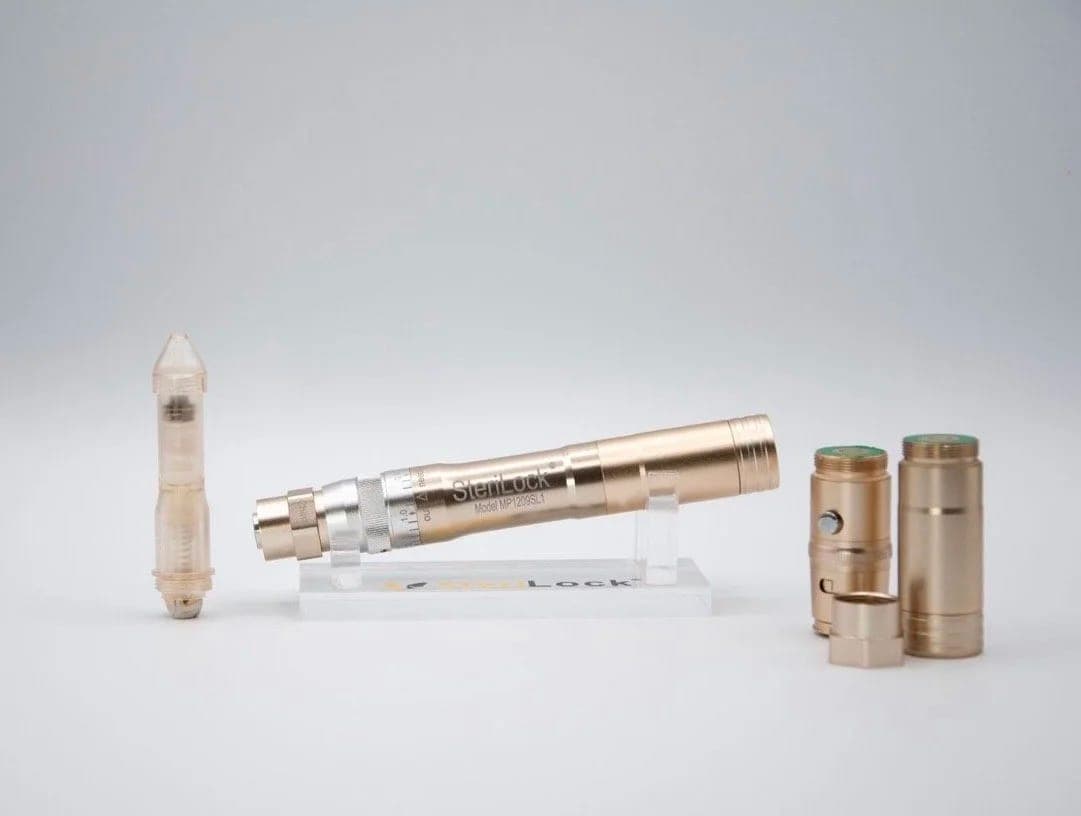
The FDA has cleared microneedling devices "for use as a treatment to improve the appearance of facial acne scars, facial wrinkles, and abdominal scars." The device we use is the SkinStylus, which per the manufacturer is "the ONLY microneedling device with FDA clearance for use on both face and abdomen," with three cartridge configurations "all cleared to 2.5mm." The manufacturer describes the sequence the same way the AAD does: "microneedling treatment creates microinjuries to the skin's surface," then "skin's natural wound healing process stimulates collagen and elastin production," and "healed skin results in visible improvement and rejuvenation."
So the order of events is: a controlled wound, your own repair response, and new collagen laid down as repair material over the following weeks and months. Nothing in that chain is instant and nothing in it is imported. The treatment is the prompt; your skin does the building, on its own schedule.
Which is also where the risk lives. The injury is the active ingredient, so more is not better - the AAD's phrase is "just the right amount of collagen," and the Academy is explicit about what happens when the judgment is wrong: "pressing too hard can damage your skin," and with at-home products "this could lead to an infection or scarring." The Academy recommends seeing a medical doctor with expertise in treating the skin, which we are not; what we are is a licensed esthetician using an FDA-cleared device within the Texas esthetician scope, with clinical protocols overseen by our Medical Director. You should know the difference before you book anywhere, including here. Your first microneedling appointment walks through what the session itself involves.
What the Biopsies Actually Showed
Most of what is written about microneedling and collagen online is mechanism - a description of what should happen. There is a smaller body of work that cut the skin open afterwards and measured. The most quoted of those is El-Domyati and colleagues, published in the International Journal of Dermatology in 2015, and it is worth reading what it did and did not find.
The design: ten patients with Fitzpatrick skin types III and IV and Glogau class II to III wrinkles were given six microneedling sessions at two-week intervals, with photographs and skin biopsies taken at baseline, one month, and three months after the start of treatment. The biopsies were then measured for epidermal thickness and for collagen types I, III and VII, newly synthesized collagen, total elastin and tropoelastin. Here is what the measurements did:
The authors' conclusion, verbatim: "Skin microneedling is a promising minimally invasive treatment option with the advantage of increased collagen production. However, multiple sessions are usually needed to maintain the improvement achieved." That second sentence is the part the industry leaves out of the quote.
The caveats, since nobody else publishes them
This is ten patients. The biopsies stopped at three months, so it says nothing about how long the new collagen persists. It studied six sessions, two weeks apart, which is a more intensive course than the three-to-five-every-two-to-four-weeks shape most people are actually sold. And the elastin result points one way while tropoelastin points the other, which the paper does not resolve and neither will we. Separately: you will see "400% more collagen" on a lot of microneedling pages. We could not trace that figure to a primary paper, so it does not appear on ours.
What Does Not Build Collagen
The word "collagen" sells things, which means most products carrying it on the label are not doing what the label implies. This is the honest sort:
The one topical with a real collagen claim behind it is a retinoid. The AAD's guidance on retinoids and retinol describes it this way: "as it spurs faster turnover of surface skin cells and boosts collagen, it also improves skin tone and reduces fine lines and wrinkles." The same page carries the cautions, which matter: "retinoids should not be used during pregnancy," and "with skin of color, irritation can trigger dark marks, known as hyperpigmentation," though "starting slowly and using moisturizer will help mitigate this possibility." The Academy also notes that because retinoids make skin more sensitive to sun, they belong in a night routine.
So the honest hierarchy is short: in-office collagen induction does the structural work, a retinoid contributes over the long run, sunscreen protects both, and almost everything else with "collagen" on the front of it is hydration and marketing in some ratio.
What on Our Menu Does It
Three of the six service categories here get described as "collagen stimulating" somewhere on the internet. Only one of them earns it. Prices below are our published menu prices:
Two things fall out of that table. First, if collagen is your actual goal, the tier you pick matters far less than whether you finish the course - $900 to $1,500 of completed sessions at $300 will do more than one admired appointment at $600. Second, if what is bothering you is a surface line rather than a structural one, the needle may not be the answer at all; best facial for wrinkles and fine lines splits those two cases, and how to get rid of acne scars does the same for marks versus true scarring.
Protecting the Collagen You Build
This is the part of the conversation that costs us money, so here it is anyway: what you do between appointments has more leverage on your result than which tier you booked. The reason is the double mechanism from earlier - sun both suppresses new collagen and speeds the breakdown of what you have. You are paying to build the thing that unprotected sun exposure is dismantling.
- Sunscreen, daily, not seasonally. The AAD's instruction is to "apply sunscreen every day to all skin that is not covered by clothing." The full specification - SPF 30 or higher, broad spectrum, water resistant, roughly a teaspoon for a face, reapplied every two hours - is set out in our microneedling aftercare guide, because the week after a session is when it matters most and most people under-apply by a wide margin.
- No tanning, at all. "Every time you get a tan, you prematurely age your skin." A tan also postpones treatment: the AAD lists recent sun exposure among the reasons to delay microneedling.
- If you smoke, that is the highest-leverage change available to you. Higher than any tier on our menu.
- A retinoid at night, once your skin has settled. The one topical with a collagen claim the AAD stands behind - with its cautions, and paused for about a week after each needling session.
- Come back before the result disappears. The AAD is clear that this is maintenance, not a cure: "as your body loses collagen, the results will fade," and a dermatologist "may also recommend that you return for a maintenance microneedling session once a year."
What Collagen Induction Will Not Do
- It is not a facelift and will not substitute for one. The AAD's guidance on firming sagging skin says minimally invasive procedures "still cannot give you the results of a surgical procedure like a facelift, eyelid surgery, or neck lift."
- It will not fix significant laxity. The same page: "Do you have lots of sagging skin? If so, skin-tightening may not be helpful." Worth adding that most of what that AAD page describes - ultrasound, radiofrequency, laser - we do not own and do not offer. If a device is what you need, we are not your studio and we will tell you so at the analysis.
- It will not work on an event timeline. Per the AAD, "results appear gradually as your body produces collagen," you "may see improvement within a few weeks," and "it usually takes several months before you see full results." For anything with a date attached, see how to prep your skin for a wedding.
- It will not replace lost volume. Collagen is structure, not fill. We offer no injectables of any kind.
- It will not treat a medical condition. Active acne, rosacea and anything needing a diagnosis belong with a physician first. A licensed esthetician in Texas cannot diagnose.
- It is not for everyone. The AAD lists people who should not have microneedling: those who "heal slowly or poorly," who "have (or had) a raised scar called a keloid," who "have a weakened immune system due to a medical condition or medication," who "are being treated for skin cancer in the area that you want microneedling," or who "are receiving radiation treatments."
- Some situations only mean "not today." The Academy also delays treatment for a tan or recent sun exposure, a skin infection, and painful or pus-filled pimples - and for isotretinoin, "at least one month must have passed since you took your last pill." Tell us about all of it at your analysis; the honest outcome of a first visit is sometimes a date in the diary rather than a treatment.
Booking Microneedling in Plano
The practical route is unchanged by any of the above: start with the skin analysis, start at SkinStylus Microneedling (Original) at $300 unless there is a reason not to, and decide the serum tier once we have actually looked at your skin. All five needling options run 60 minutes. Which microneedling is right for you lays out the full ladder, and how many sessions you need covers the schedule and what a course costs.
Treatments are performed by founder and licensed esthetician Leila Razipoor, who is HydraFacial and microneedling certified, with clinical protocols overseen by our Medical Director, Dr. Brady Steineck, MD. Our clients have rated the studio 5.0 stars across 68 Google reviews. Browse the full treatment menu or get in touch, and we will start with the analysis rather than with the upsell.