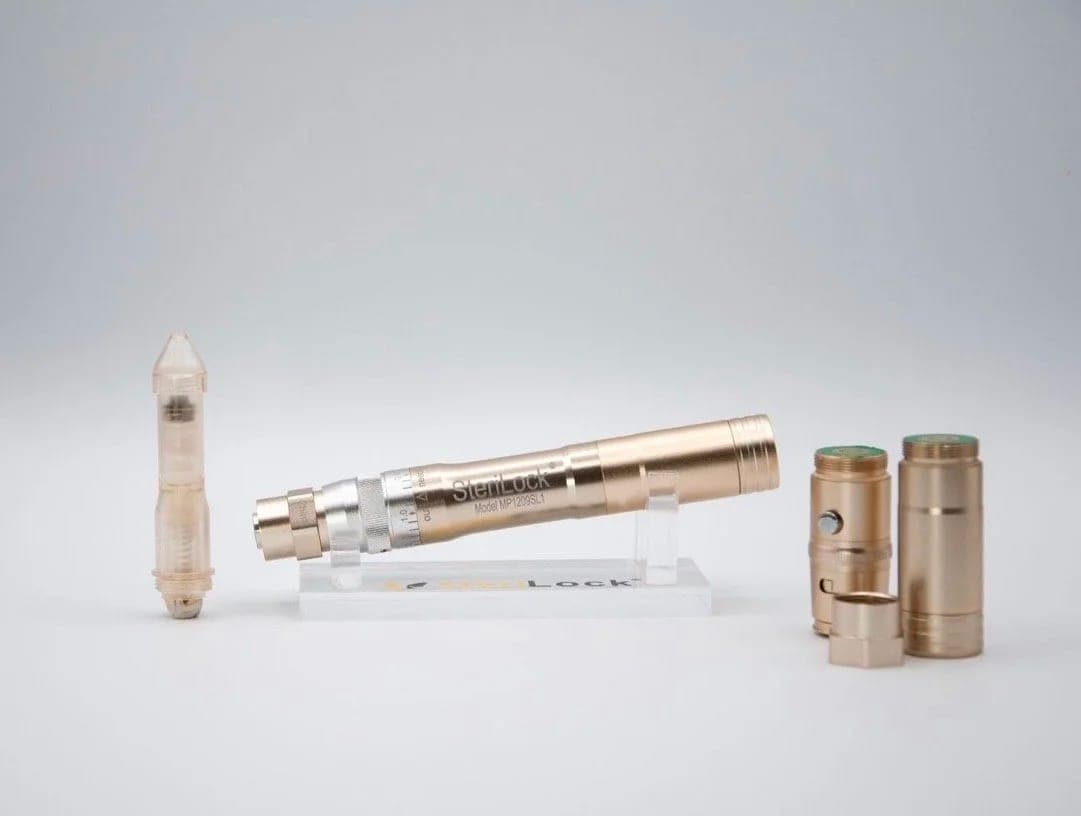
Of all the decisions on our microneedling menu, this is the one people stall on at the counter: Microneedling + Brightening GF Serum at $400, or Microneedling + Brightening Exosomes at $500. One hundred dollars apart, the same hour, the same device, the same numbing cream.
So here is the honest version of what that $100 buys, what growth factors and exosomes actually are, what the FDA says about the latter, and why we are not going to tell you one outperforms the other by some percentage.
The one-line version
The needling is identical on both tiers. Same SkinStylus device, same 60 minutes, same numbing, same depth decision made at your analysis - and the needling is what builds the collagen. What changes is the serum infused afterward: individual signaling proteins on the $400 tier, or vesicles carrying a mixed payload of signals on the $500 tier. Both include LED and a soothing mask. Neither shortcuts the months it takes your own collagen to show up.
The Short Answer
If this is your first microneedling, neither - start at SkinStylus Microneedling (Original) ($300) and see how your skin behaves before you commit to a longer course at a higher price. We say that to people's faces and it costs us money, which is roughly how you can tell we mean it.
If you have had microneedling before and you are choosing between the two upgrade tiers, the honest framing is this: you are not buying a stronger treatment. The depth, the device and the hour are the same. You are buying a different post-needling infusion, and the difference between the two is the kind of signaling that gets delivered, not the amount of correction.
And if you are addressing several things at once - scarring and tone and fine lines together - the conversation is usually not about these two tiers at all, but about Microneedling + PEARL Exosomes at $600, which is the exosome system plus PDRN, PDGF, antioxidants and amino acids.
What Actually Changes Between Them
It is worth being precise about how little changes, because the price gap implies more than it delivers. The appointment is the same appointment:
- The same device. SkinStylus, with a sterile single-use cartridge, on both tiers.
- The same depth decision. Made at your skin analysis, based on your skin and the area, not on which tier you booked.
- The same hour and the same numbing. Both are 60-minute appointments with numbing cream applied for comfort - see your first microneedling appointment for the step-by-step.
- The same aftercare and the same downtime. Redness for roughly 24 to 72 hours either way; our aftercare guide applies identically to both.
- The same finish. LED light therapy and a soothing mask are included on both tiers, not billed separately.
What changes is one step: what we infuse into freshly needled skin. Our menu describes the $400 tier as "AnteAGE growth factors and skin-repair proteins" and the $500 tier as "AnteAGE exosomes support repair, hydration, and advanced collagen renewal." That is the entire difference, and the rest of this page is about what those two phrases mean.
What a Growth Factor Is
A growth factor is a signaling protein. Your body makes them constantly, and their job is to tell cells what to do next - divide, migrate to a wound, lay down new matrix. They are the instructions, not the building material.
That is why they are paired with microneedling rather than sold as a cream. Needling creates a brief window where the skin's barrier is open and a repair response is already underway, and a growth factor serum applied into that window is arriving at the moment the skin is listening. Applied to intact skin on a Tuesday afternoon, most of the same molecules are too large to get anywhere interesting.
What a growth factor serum is not is a shortcut. It supports a repair process that the needling started; it does not start one of its own.
What an Exosome Is
An exosome is not a growth factor. It is a tiny vesicle - a membrane-bound packet that cells release to communicate with each other - and the signaling molecules it carries are its cargo rather than its identity. Where a growth factor serum delivers specific proteins, an exosome preparation delivers packets carrying a mixed payload of signals.
That is the genuine conceptual difference between the two tiers, and it is the most defensible thing anyone can tell you about them. What follows is the part the industry usually leaves out.
What the FDA says about exosomes
The FDA states plainly that "There are currently no FDA-approved exosome products" and that exosome products "intended to treat diseases or conditions in humans require FDA approval." The agency warns that patients may be misled by products that are "illegally marketed," that "have not been shown to be safe or effective," and that some may "have significant safety issues that put patients at risk."
We publish that rather than bury it, and we would rather you read it here than find it afterward. What we use is a professional topical serum applied to the skin after needling - it is not injected, and we make no claim that it treats any disease or condition. But "no FDA-approved exosome products" is a true sentence about the whole category, including ours, and you are entitled to weigh it before spending the extra hundred dollars.
If you are weighing exosomes against the other add-on people ask about, microneedling with exosomes vs PRP is the longer answer - short version, PRP needs a blood draw, which is outside an esthetician's scope, so we offer exosomes and refer PRP out.
The Two Tiers, Side by Side
What the Evidence Supports
This is the section that should decide it for you, and it is mostly about microneedling rather than about serums.
The American Academy of Dermatology describes how microneedling works in one sentence: "It works by stimulating your body to make collagen." On timing, the AAD is equally plain - "Results appear gradually as your body produces collagen," you "may see improvement within a few weeks," and it "usually takes several months before you see full results." For acne scars specifically, "you may need 3 to 5 treatments, which are performed every 2 to 4 weeks."
Read that against the two tiers. The result you are paying for is your own collagen, produced over months, in response to the needling - which is the same on both. Neither serum changes that mechanism and neither compresses that timeline.
What we will not do is put a number on the gap between them. There is no published head-to-head trial comparing these two serums at these two prices, and anyone quoting you a percentage improvement for one over the other is quoting something they cannot support. We would rather tell you exactly what is in each and let you decide, which is what the table above is for.
The AAD also recommends seeing "a medical doctor who has expertise in treating the skin," such as a board-certified dermatologist, for microneedling. Our actual credentials are published on our about page: treatments are performed by a licensed esthetician, with clinical protocols overseen by our Medical Director. Esthetician vs dermatologist covers where that line sits.
If Your Main Goal Is X, Book Y
The Series Math
This is the arithmetic that should carry more weight than the serum debate, and almost nobody does it before booking. Microneedling is a series, not an appointment. Taking the AAD's 3 to 5 treatments for acne scarring as the shape of a course:
Across a five-session course the $100 gap becomes $500. That is the number worth deciding on, not the per-session one - and it is the reason our standing advice is to choose the tier you can finish rather than the tier that impresses once. Three completed sessions at $400 will do more for your skin than one admired session at $500 and a course you never came back for.
You can also mix tiers across a course - there is no rule against it, and we will not upsell you into consistency for its own sake. How many microneedling sessions you need covers the spacing, and how much microneedling costs in Plano lays out the whole menu against what else that money buys here.
What Neither Serum Will Do
- Neither makes the needling deeper. Depth is set at your analysis for your skin and the area being treated. It is not a tier feature and it is not for sale.
- Neither shortens the timeline. Per the AAD it "usually takes several months before you see full results," because you are waiting on your own collagen.
- Neither reduces downtime. Redness for roughly 24 to 72 hours either way, and the same aftercare applies.
- Neither is a substitute for the series. One session at the top tier is not three sessions at the foundation tier, and no serum changes that.
- Neither treats a medical condition. Active acne, rosacea and anything requiring a diagnosis belong with a dermatologist, not a serum choice.
- We do not offer RF microneedling. If you have been quoted radiofrequency microneedling elsewhere, that is a different device category and a different conversation - it is not on our menu.
Booking Microneedling in Plano
The practical route: book the tier you are comfortable repeating, and settle the serum at your analysis once we have looked at your skin. Microneedling + Brightening GF Serum is $400 and Microneedling + Brightening Exosomes is $500; both run 60 minutes with LED and a mask included. If you want the whole ladder laid out first, which microneedling is right for you covers all five options including nanoneedling.
Treatments are performed by founder and licensed esthetician Leila Razipoor, who is HydraFacial and microneedling certified, with clinical protocols overseen by our Medical Director, Dr. Brady Steineck, MD. Our clients have rated the studio 5.0 stars across 63 Google reviews. Browse the full treatment menu or get in touch, and we will start with the analysis.