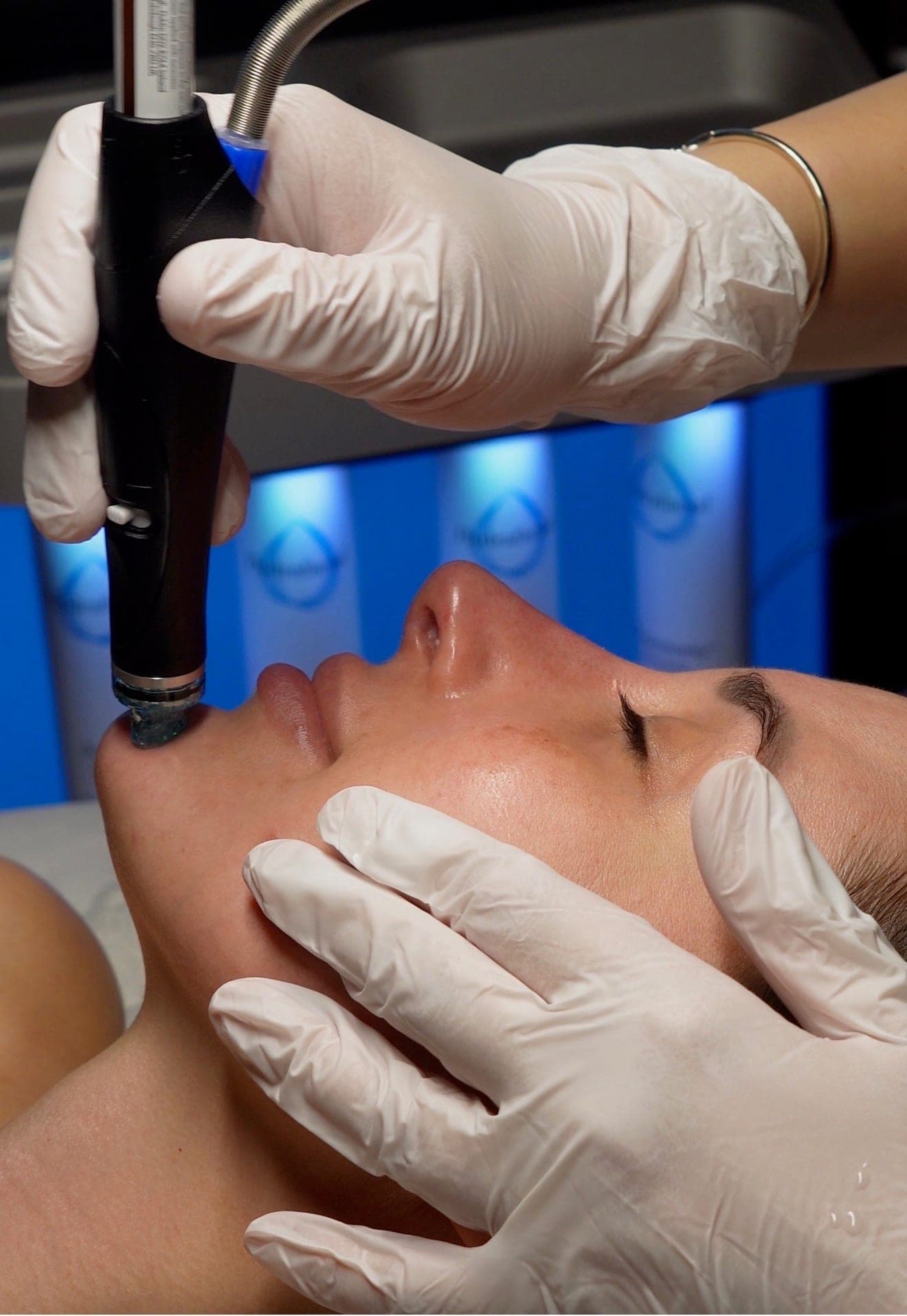
These three treatments get compared constantly, usually on price, and price is the least useful thing about them. They are not three strengths of the same idea. They are three different mechanisms aimed at three different problems, and the person who books the most expensive one for a job it cannot do has not bought an upgrade - they have bought the wrong treatment.
The one-line version
HydraFacial cleans, extracts and hydrates with no downtime - congestion, dullness, dehydration, event prep. From $190. Chemical peel resurfaces the surface layer - pigment, rough texture, acne and congestion that keep returning. $225, all three peels. Microneedling stimulates collagen below the surface - depressed acne scars, texture and fine lines. From $300, with nanoneedling at $150 as the no-downtime option.
The Short Answer
Ask one question first: do you want your skin maintained, resurfaced, or rebuilt?
- Maintained - it is broadly healthy and you want it clean, hydrated and glowing on a schedule. That is a HydraFacial or a corrective facial.
- Resurfaced - something on the surface needs changing: dark marks, rough texture, congestion that refills. That is a chemical peel.
- Rebuilt - something below the surface is missing: a depressed scar, lost firmness, lines you can see in any light. That is microneedling.
Most people, over a year, use more than one. Correction first, maintenance after - and the sequencing matters more than the individual choice, which is what the second half of this page is about.
All Three, Side by Side
If Your Main Goal Is X, Start With Y
This is the table most people actually came for. Start from the goal, not the price, and treat every row as a starting point we confirm at your skin analysis rather than a prescription.
What Each One Is Actually For
HydraFacial - maintenance and no-downtime results
A device running a fixed sequence: cleanse, exfoliate, extract and hydrate, with a booster and LED light therapy on the Deluxe HydraFacial ($270) and lymphatic drainage added on the Platinum HydraFacial ($320). The Signature HydraFacial is 30 min at $190.
Its advantage is reliability. No downtime, immediate result, easy to run every 4 to 6 weeks indefinitely. Its limit is that everything it does is on or just below the surface - it will not resurface a scar or erase a static line, and we say so plainly in are HydraFacials worth it.
Chemical peel - resurfacing and correction
Three Circadia peels, all $225: the Lactic Acid Peel Facial (60 minutes) for dry, dull or mature skin, the Alpha-Beta Peel Facial (60 minutes) for congestion and oil, and the Mandeliclear Chemical Peel (30 minutes) as the corrective peel for acne and pigment. The first two have little to no downtime; the third is expected to produce some dryness or light peeling for a few days.
Peels are bought as a course - the AAD's guidance for this category is 3 to 5 peels repeated every 2 to 5 weeks - and they make the strongest case when the problem is color or surface texture. All three sit in the gentlest category of peel; we do not perform medium or deep peels, which are a dermatologist's procedure.
Microneedling - collagen and structure
Five lines on the menu, from SkinStylus Nanoneedling at $150 through SkinStylus Microneedling (Original) at $300 to Microneedling + PEARL Exosomes at $600. The needling is identical across all four microneedling tiers - what changes is the serum system infused afterward, which is explained in full in the microneedling pillar guide.
This is the only one of the three that remodels tissue, which is why it is the answer for depressed scarring and the wrong answer for surface pigment. It is also the one with genuine downtime: redness like a light sunburn for roughly 24 to 72 hours. Nanoneedling is a different treatment rather than a cheaper version - glow and serum absorption without injury, and it will not resurface a scar.
The Fall Skin Reset
Autumn is when most of our correction plans start, and the reason is sun. Both peels and microneedling leave skin more vulnerable for a while, and the AAD is direct that after a peel your "risk for developing an infection or scarring increase dramatically" if you fail to protect your skin from the sun. Shorter days and more time indoors make that job easier, which is the whole argument in why fall and winter are peel season.
What a season typically looks like, using the published intervals for each treatment. This is the usual shape rather than a prescription, and we confirm yours at the skin analysis.
- Start with the analysis. Included in every appointment, no consultation fee. It decides which treatment leads and whether anything needs to happen first - a prep routine, or calming inflamed skin.
- Run one correction course, not two. Either a peel series (3 to 5 peels, every 2 to 5 weeks per the AAD) or a microneedling series (3 to 5 sessions, every 2 to 4 weeks), depending on whether the goal is surface or structural. Picking one and finishing it beats alternating between both.
- Keep maintenance light while the course runs. A Signature HydraFacial at $190 is the usual between-sessions treatment where it fits, because it is the one with no exfoliation load attached - spaced away from the corrective appointments, not alongside them.
- Protect it the whole way through. Daily broad-spectrum sunscreen is the part doing the long-term work, during the course and after it.
- Settle into a rhythm afterward. Most clients finish a course and move to a HydraFacial or a corrective facial every 4 to 6 weeks, returning to peels or microneedling when there is something new to correct.
- Leave event weeks clear. Nothing corrective in the fortnight before something that matters. That is what the no-downtime treatments are for.
If your goals genuinely span both surface and structure - pigment and scarring, say - the usual answer is sequence rather than simultaneity: finish one course, give the skin a rest, then start the other. It takes longer. It also works, and it does not leave your barrier in pieces by December.
What We Will Not Stack
The most common way people arrive at tight, stinging, unexpectedly broken-out skin is by buying two good treatments too close together. The AAD's exfoliation guidance is blunt about the result: "Be careful not to over-exfoliate, as this could lead to skin that is red and irritated."
- Two exfoliating treatments in the same fortnight. A peel and a resurfacing facial, or a peel and microneedling, close together. Tell us what you have had elsewhere and we will space it properly.
- A corrective treatment before an event. Not in the two weeks before. Ever.
- A professional treatment plus a full-strength home routine. Retinol, prescription retinoids and acid toners count toward the same total, and we will tell you what to pause and when to restart it.
- Anything on compromised skin. Sunburn, open or broken skin, an active flare or infection. The AAD's rule is not to exfoliate any of it, and we follow that rule.
What We Settle at Your Skin Analysis
Every appointment opens with a professional skin analysis, included rather than billed as a consultation. Which treatment leads is the easy half of that conversation. The half that matters more is sequencing, spacing and how many sessions your skin actually needs - none of which a price list can tell you.
It is also where screening happens. Tell us about prescription medications including isotretinoin and retinoids, retinol and acids at home, recent waxing, lasers or peels elsewhere, a history of cold sores, pregnancy or nursing, and any active infection or breakout in the area. For microneedling the AAD also advises against treatment if you heal slowly or poorly, have or have had a keloid scar, or have a weakened immune system - we ask about all three before we treat.
And if what you need is a dermatologist rather than a treatment room, you will get that answer. Esthetician vs dermatologist maps exactly where that line sits in Texas.
Booking in Plano
Everything above is on our published price list: HydraFacial from $190, chemical peels at $225, and microneedling from $150 for nanoneedling and $300 for the foundation microneedling treatment. There is no consultation fee - the analysis that decides between them is part of the appointment.
Treatments are performed by founder and licensed esthetician Leila Razipoor, who trained at Collin College and is HydraFacial and microneedling certified, with clinical protocols overseen by our Medical Director, Dr. Brady Steineck, MD - our methodology page explains how that oversight works. Our clients have rated the studio 5.0 stars across 62 Google reviews. Browse the full treatment menu or get in touch and we will start with the analysis.
Frequently Asked Questions
Keep exploring